E-commerce: Promotion and Launch of an Online Store
Useful articles and guides on promoting, launching, and developing online stores in the E-commerce field

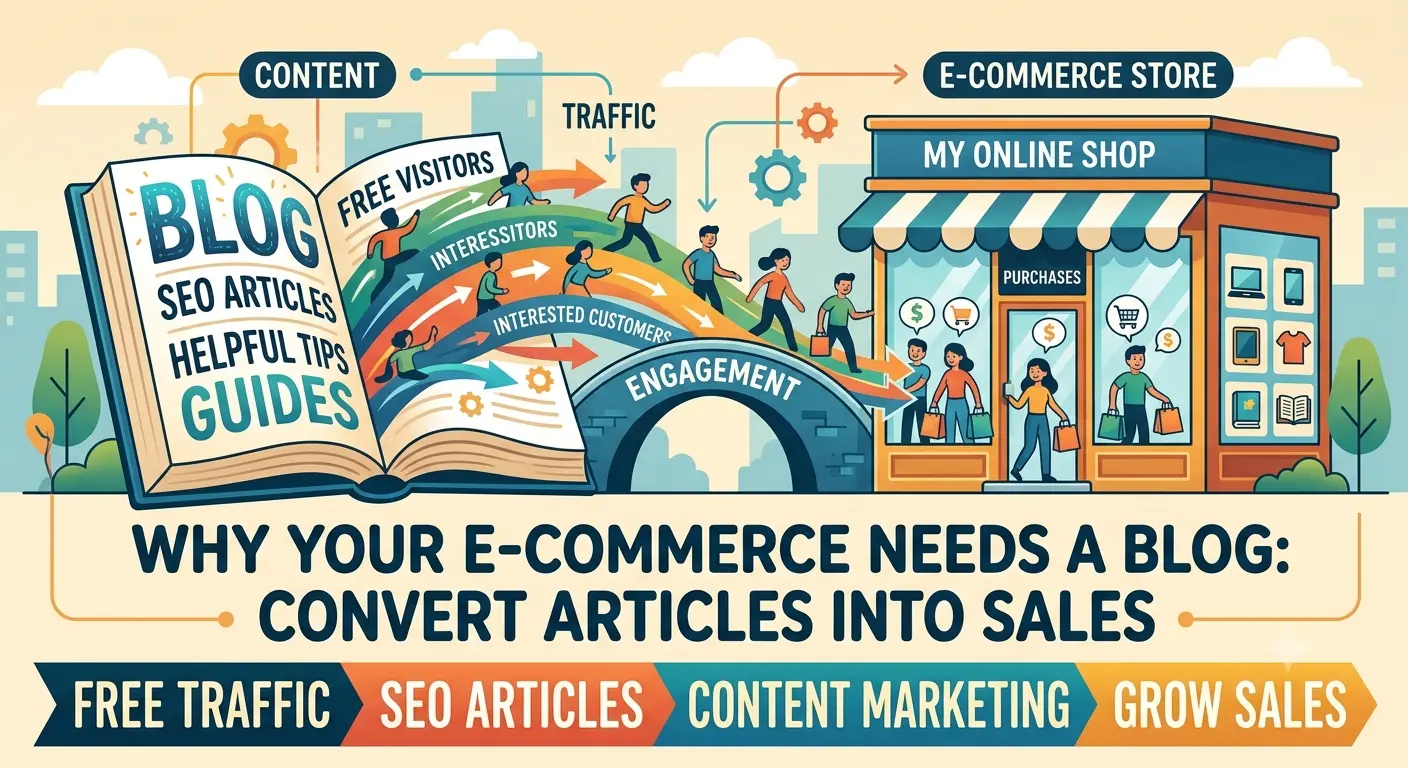
Why an Online Store Needs a Blog: How to Turn Informational Articles Into a Constant Stream of Free Customers


Why an online store needs a blog: content marketing for e-commerce


Why an Online Store Needs a Blog: How to Turn Informational Articles Into a Constant Stream of Free Customers

Explaining the value of content marketing for online store owners. How to write articles on topics customers are searching for and gently convert that traffic into purchases. No jargon — just practical advice.

Why a Blog Is Your Store's Second Showcase

Most online store owners see a blog as something secondary. "Sales first, blog later, somehow." And that's understandable: when you need to launch products, set up delivery, and figure out advertising, writing articles doesn't seem like a priority.

But there's one problem: contextual advertising only works as long as you pay. The cost per click rises every year — in some niches, a lead through Google Ads already costs $5-$10. A blog, however, is an asset that works for years. An article written once can bring customers for 2-3 years with no additional investment.

I manage content marketing for a climate control equipment store. Two articles a month — and after six months, 40% of orders came from search traffic from those articles. For free.

The core idea is simple: people search Google not for products, but for answers to questions. "How to choose an air conditioner?" — that's a query. If you give a great answer and offer the right air conditioner, the customer will come to you on their own.

The Math of Content Marketing

Let's break down why a blog is more profitable than advertising alone.

ParameterAdvertising onlyAdvertising + blog
Cost per click (Google Ads)$1-$10$0 (organic traffic)
DurationAs long as you payYears after publication
Visitor trustMedium (ads get blocked)High (came for information)
Conversion from traffic1-3%3-8% (warm leads)
Link buildingNoneOther sites link to articles
Brand awarenessLowGrows with every article

I have a friend who runs a coffee and coffee machine store. He spent a year blogging: writing coffee machine reviews, comparing models, talking about coffee varieties. After 14 months, when he published his 30th article, search traffic overtook ad traffic. Now he spends 3 times less on advertising than a year ago — and sales have grown.

What to Write About: 5 Types of Articles That Work

The main mistake beginners make is writing about their store in a "we opened" or "we have discounts" style. Nobody needs those articles. People look for useful information, not ads. Here are 5 formats that actually work:

1. "How to Choose..."

The most conversion-friendly format. "How to choose a washing machine", "How to choose a bike for a child". The person is in the process of choosing — they're ready to buy, they just need help. You help and offer your product.

2. Model Comparisons

"Smartphones under $500: comparing 5 models". People love comparisons. If the article features your products with prices — conversion to purchase is high.

3. Reviews and Tests

"Xiaomi vacuum cleaner review — is it worth the money". Readers trust honest reviews. If you evaluate a product objectively, people will keep coming back to read you.

4. Guides and Life Hacks

"How to extend your laptop battery life". Useful tips get bookmarked and shared on social media. This expands your reach.

5. News and Trends

"What's new in iPhone 17: spec breakdown". If you follow trends in your niche, people will read you as an expert. And experts are trusted.

6. FAQ Answers

Collect questions customers ask support and write an article for each one. This reduces support load and brings new customers from search.

Important rule: Don't write "fluff". A 2000-character article won't fool anyone — Google sees there's little content and ranks it lower. A good article is 5000+ characters with real examples, numbers, and personal experience.

How SEO Articles Bring Customers

For an article to drive traffic, it needs to be properly optimized. Basic SEO rules for an online store blog:

  • Key query in the H1 heading — "How to choose an air conditioner for your apartment", not "Tips for choosing an air conditioner". The second option is searched for less often.
  • Meta Title (40-60 characters) — contains the key query plus a number or promise: "How to choose an air conditioner: 5 criteria + 2024 rating".
  • Meta Description (150-160 characters) — an expanded description with the key query and a call to read more.
  • H2, H3 subheadings — break the text into logical blocks and contain additional key queries.
  • Internal links — link from the article to your store's products and categories. But don't overdo it: 2-3 links per article is enough.
  • Images with ALT tags — every image should have an ALT with a description containing a keyword.
  • SEO-friendly URL — the article URL should contain a transliteration of the title: /how-to-choose-air-conditioner.
On BooStore.pro: All SEO settings for articles are available in the admin panel. Meta Title, Description, SEO-friendly URL, H1, Schema.org Article — all filled in the article card. Article categories help structure your blog, and internal links to products are added through the visual editor. Guide to working with the article catalog.

Additional SEO Recommendations for Your Blog

To keep your articles consistently ranking in top search results, follow a few simple rules:

  • Research keywords — use Google Keyword Planner, Ahrefs, or SEMrush to find queries people are actually searching for in your niche. Focus on long-tail keywords — they're easier to rank for.
  • Loading speed — Google considers Core Web Vitals. On BooStore.pro, PageSpeed scores reach 99-100 points, giving you a ranking advantage. Learn more about the platform.
  • Internal linking — link articles to each other and link to products from the text. This distributes page authority and helps search bots better understand your site structure.
  • Mobile version — over 60% of traffic comes from phones. The blog on BooStore.pro automatically adapts to mobile devices. You can also set up mobile menu.
  • Schema.org markup — BooStore.pro automatically adds Article, Breadcrumbs, and Reviews microdata to articles. This increases CTR in search results through rich snippets.
  • Regular updates — search engines love sites that constantly add new content. Use scheduled publishing to maintain a stable article release schedule.

Read the full guide to SEO promotion for online stores in a separate article: SEO Promotion Recommendations for Websites.

How to Soft-Sell Through a Blog

Many fear that a blog is "just for fun" with no sales. In reality, selling through a blog works more gently and effectively than direct advertising. Here's how it's done:

The "Problem → Solution → Product" Framework

Write an article about a customer's problem. In the solution process, show that your product is the best option.

The "Review → Comparison → Recommendation" Framework

A review of several models with honest comparison. At the end — a conclusion on which model to choose and for whom. Naturally, your store offers these models.

The "FAQ → Article → Category" Framework

Frequently asked questions → in-depth article → link to the product category that solves the problem.

Example: a sportswear store. Article "How to choose running shoes: a complete guide". Inside — recommendations by pronation type, runner weight. At the end — "Browse running shoes in our catalog". No pushing, just a logical next step.

Case study: A sports goods store. Wrote an article "How to choose thermal underwear for winter runs". The article had 3 links to specific thermal underwear models from the catalog. After a month — 1,200 visits from search, 38 orders of thermal underwear. Cost of the article — 3 hours of the author's time.

Real Case Study: Store + Blog = 3x Growth

Let me tell you about an auto parts store. The owner spent six months pouring budget into Google Ads — $2,000/month, sales at $6,000. Low profitability due to high cost per click in this niche.

We started a blog. Articles: "How to distinguish genuine spark plugs from fakes", "What antifreeze to use in a Mazda CX-5", "Timing belt replacement intervals: table for popular cars".

After 6 months:

  • 15 articles on the blog
  • 5,000+ visits from search per month
  • Ad budget reduced to $750/month
  • Sales grew to $9,000/month
  • Blog brings 60% of new orders

The owner was surprised that articles work better than paid ads. But it makes sense: someone searching "how to spot fake spark plugs" is already ready to buy spark plugs. They just need a reliable seller.

Using AI (ChatGPT) for Article Generation

One of the biggest problems for online store owners is lack of time for writing articles. Hiring a copywriter costs money, and writing yourself takes hours. The solution — using artificial intelligence, such as ChatGPT, for content generation.

How AI Helps in Content Marketing

  • Speed: ChatGPT can write a 5,000-character article in 1-2 minutes. You edit, polish, and publish — instead of 3 hours, you spend 15 minutes.
  • Scaling: You can create dozens of articles a day, covering hundreds of search queries in your niche.
  • SEO optimization: AI can embed keywords, write meta-title and description, and create a structure with H2/H3.
  • Consistent style: Set the template and tone once — all articles will maintain a consistent manner.
  • Commercial and non-commercial articles: AI writes both useful informational materials ("How to choose...") and commercial reviews with product recommendations equally well.

How to Properly Task ChatGPT

The key to a quality result is a good prompt. Here's an example of a well-crafted task:

"Напиши статью для блога интернет-магазина на тему 'Как выбрать кондиционер для квартиры'. Структура: 1. Заголовок H1 с ключевой фразой. 2. Введение — почему важно правильно выбрать кондиционер. 3. Критерии выбора: мощность, тип, инвертор/не инвертор, бренд. 4. Сравнение популярных моделей (таблица). 5. Советы по установке. 6. Заключение с призывом посмотреть каталог кондиционеров. Объём — 5000-7000 символов. Стиль — информативный, без воды. SEO: ключевые слова — 'выбрать кондиционер', 'какой кондиционер купить', 'кондиционер для квартиры'."

Ideas for Articles You Can Generate with AI

Informational Articles

"How to choose...", "What's better...", "A guide to...". These articles answer user questions and bring free traffic from search.

Comparison Reviews

"Smartphone A vs B: which to choose?". Comparisons convert well since the reader is already in the decision-making process and ready to buy.

News and Trends

"What's new in the 2025 model". Such articles attract audiences who follow new releases.

FAQ and Answers

"Frequently asked questions about...". Q&A format articles rank well for voice search queries.

Important: Don't publish AI-generated text without review. Always edit: add personal experience, facts, figures, unique details. Google can distinguish "watery" AI content. Make the article useful — and it will rank in the top.

A detailed guide with example prompts and settings — in the article How to Use ChatGPT for Filling Your Online Store.

Blog Automation: Scheduled Publishing and Article Import NEW

Running a blog requires regularity. Search engines love sites that update on a schedule: Google considers content freshness as a ranking factor. But how do you publish articles regularly if you don't have time every day?

The BooStore.pro platform offers two powerful tools that fully automate content marketing:

Scheduled Article Publishing

The Scheduled Publishing feature lets you schedule an article for any future date and time. You prepare materials in advance, and the system publishes them automatically — without your involvement.

How it works:

  • When creating an article, set the desired publication date and time.
  • Enable the "Scheduled Publishing" checkbox.
  • Disable "Publication Access" to hide the draft from visitors and search bots until the specified date.

That's it! The system will publish the material exactly on time. This is especially convenient for content plans a month ahead: you can prepare 8-10 articles in one day and space them out across dates.

This matters for SEO: Search engines see that the site is regularly updated and increase their trust in it. Regular publishing is one of the factors for improving search rankings.

Importing Articles from Excel and Google Sheets

If you already have ready texts or ordered articles from a copywriter in bulk, you don't need to add them one by one manually. BooStore.pro supports mass article import from XLS, CSV, and Google Sheets files.

What you can import:

  • Article titles and texts (with HTML markup).
  • SEO metadata: Meta Title, Description, Keywords.
  • SEO-friendly URLs.
  • Article categories.
  • Images (by links).
  • Publication dates and scheduled publishing status.

This lets you import 50-100 articles in 5 minutes and schedule their publication. Learn more about store automation on BooStore.pro.

Tip: Combine scheduled publishing with import. Prepare 20-30 articles for a month in a Google Sheet (written yourself or generated through ChatGPT), import them in 5 minutes, and spread them across dates. Done — content marketing set for a month ahead.

Blog on BooStore.pro: All in One Place

In the past, an online store blog required a separate CMS (WordPress) or plugin. That meant: separate design, separate SEO settings, separate database, integration with duct tape.

On BooStore.pro, the blog is a built-in module. Everything works in a single ecosystem. The platform also lets you create service booking websites (Booking), landing pages, corporate sites, and multilingual hypermarkets — with a single admin panel, design, and SEO settings.

Here's what's available for the blog out of the box:

Built-in Article Catalog

Article categories, announcement list, individual pages for each article. All in the admin panel, no WordPress needed.

SEO Out of the Box

Meta Title, Description, SEO-friendly URL, Schema.org Article, robots.txt, sitemap.xml — all generated automatically for each article.

Internal Links to Products

You can add product widgets or category links to article text. No separate configuration needed.

Scheduled Publishing

Plan article releases weeks ahead. Write 10 articles in one day — the system will publish them on schedule.

Excel Article Import

Mass import articles from XLS, CSV, Google Sheets. Upload 50 articles with SEO metadata at once and schedule their publication. Automation on BooStore.pro.

Unified Design

The blog uses the same styles, header, footer, and menu as the store. No need to separately configure responsiveness. An article is created and published without designers or developers. All features are available for free to start.

Reviews with Ratings

Built-in review and rating system for articles. Data passed to search engines (Schema.org).

Free to Start

Up to 300 articles on the free plan. That's enough for a year of regular publishing. More about plans.

SEO Promotion Recommendations for Your Blog NEW

For your blog to consistently bring traffic, it's important not only to write articles but also to promote them properly. Here are key recommendations for SEO optimization of an online store blog:

1. Keyword Research

Before writing an article, make sure there are search queries on that topic. Use Google Keyword Planner, Ahrefs, or SEMrush. Choose queries with medium competition — it's realistic to rank in the top 10 within 2-4 months. Focus on informational queries: "how to choose", "what's better", "review", "comparison".

2. Article Structure

Proper structure helps both readers and search bots:

  • H1 — article title (one per page).
  • H2 — main sections of the article.
  • H3 — subsections within H2.
  • Use lists, tables, and highlighting for important content.
  • Optimal length — from 5,000 characters.

3. Meta Tags

Fill in for every article:

  • Meta Title — 40-60 characters, contains the key query, grabs attention.
  • Meta Description — 150-160 characters, reveals the article's essence and includes a call to action.
  • Meta Keywords — 3-5 key phrases (supplementary).

4. Internal Linking

Every article should link to other articles and to store products/categories. This distributes page authority and helps visitors move toward a purchase. On BooStore.pro, internal links are added through the visual editor in a couple of clicks.

5. Loading Speed

Google considers loading speed when ranking. On BooStore.pro, Core Web Vitals scores reach 99-100 points thanks to optimized architecture, data compression, caching, and CDN for scripts.

6. Regularity and Content Freshness

Publish at least 2-4 articles per month. Use scheduled publishing to maintain a stable schedule. Update old articles: add new data, change outdated information, improve structure.

Full guide: Detailed SEO promotion recommendations for online stores with code examples, meta tags, Schema.org markup, and mobile version settings — in the article SEO Promotion Recommendations for Websites.

A Blog Is a Free Sales Department That Works 24/7

One well-written article can bring tens of thousands of visitors per year. For free. Unlike advertising, which stops when the budget runs out.

Start with one article a week. In 3 months, you'll have 12 articles working for you. In a year — 50+, a full-fledged sales channel.

❓ Frequently Asked Questions About Online Store Blogs

Answers to the most common questions store owners have about content marketing.

How many articles do I need to publish to see results?

At least 2 articles per month, ideally 4-8 articles per month. First results (10-30 visits per day from search) will appear after 3-4 months of regular publishing. Serious traffic (100+ visits per day) — after 6-9 months. This is a normal timeframe for SEO. If you need faster results, combine the blog with contextual advertising.

Where do I get ideas for articles?

The easiest source — customer questions from support. Write down what they ask and write answer articles. The second source — Google Search Console: see what queries are already bringing you traffic and create in-depth articles on them. The third — competitors: analyze which articles rank in the top for your queries and make better ones.

Can I order articles from copywriters?

Yes, but it's important to control quality. A good SEO article is not just text on a topic. It's structure, keywords, internal links, meta tags, and unique experience. Cheap copywriters ($1-$3 per 1000 characters) write "fluff" that Google won't rank. Better to pay an expert in your niche ($5-$15 per 1000 characters) — conversion will be many times higher.

Blog on subdomain or in a folder: what's better for an online store?

Always in a folder (site.com/blog/), not on a subdomain (blog.site.com/). From an SEO perspective, links from articles in a folder pass more authority to the main site. On BooStore.pro, articles are located inside your site, not on a separate subdomain — that's the correct architecture for SEO.

How much does the built-in article module on BooStore.pro cost?

The article module is part of the platform's basic functionality and is available on all plans, including the free plan (up to 300 articles). On paid plans (from $3/month), the limit increases to 1,000+ articles. More details — BooStore.pro plans and features.

How does scheduled article publishing work?

When creating an article, you set the desired publication date and time, enable the "Scheduled Publishing" option, and disable "Publication Access" to hide the material from visitors and search engines until the specified date. The system will automatically publish the article at the scheduled time. This lets you prepare a content plan months ahead in just one day.

Can I use ChatGPT to write articles for my store's blog?

Yes, ChatGPT is great for generating article drafts. You provide the topic, structure, and keywords — AI writes the text in minutes. It's important to refine the material: add unique details, personal experience, facts, and figures. Google can consider "raw" AI content as low quality. Detailed guide — How to Use ChatGPT for Filling Your Online Store.

Can I import articles to the blog in bulk?

Yes, BooStore.pro supports bulk article import from XLS, CSV, and Google Sheets. You can import titles, full texts (with HTML), SEO metadata, SEO-friendly URLs, categories, and publication dates. This lets you import 50-100 articles in 5 minutes and schedule their publication. Learn more about automation on BooStore.pro.


; $content = $m.Groups[2].Value if ($content.EndsWith($suffix)) { $m.Groups[1].Value + $content.Substring(0, $content.Length - $suffix.Length) + $m.Groups[3].Value } else { $m.Value }

Why an online store needs a blog: content marketing for e-commerce


Why an Online Store Needs a Blog: How to Turn Informational Articles Into a Constant Stream of Free Customers

Explaining the value of content marketing for online store owners. How to write articles on topics customers are searching for and gently convert that traffic into purchases. No jargon — just practical advice.

Why a Blog Is Your Store's Second Showcase

Most online store owners see a blog as something secondary. "Sales first, blog later, somehow." And that's understandable: when you need to launch products, set up delivery, and figure out advertising, writing articles doesn't seem like a priority.

But there's one problem: contextual advertising only works as long as you pay. The cost per click rises every year — in some niches, a lead through Google Ads already costs $5-$10. A blog, however, is an asset that works for years. An article written once can bring customers for 2-3 years with no additional investment.

I manage content marketing for a climate control equipment store. Two articles a month — and after six months, 40% of orders came from search traffic from those articles. For free.

The core idea is simple: people search Google not for products, but for answers to questions. "How to choose an air conditioner?" — that's a query. If you give a great answer and offer the right air conditioner, the customer will come to you on their own.

The Math of Content Marketing

Let's break down why a blog is more profitable than advertising alone.

ParameterAdvertising onlyAdvertising + blog
Cost per click (Google Ads)$1-$10$0 (organic traffic)
DurationAs long as you payYears after publication
Visitor trustMedium (ads get blocked)High (came for information)
Conversion from traffic1-3%3-8% (warm leads)
Link buildingNoneOther sites link to articles
Brand awarenessLowGrows with every article

I have a friend who runs a coffee and coffee machine store. He spent a year blogging: writing coffee machine reviews, comparing models, talking about coffee varieties. After 14 months, when he published his 30th article, search traffic overtook ad traffic. Now he spends 3 times less on advertising than a year ago — and sales have grown.

What to Write About: 5 Types of Articles That Work

The main mistake beginners make is writing about their store in a "we opened" or "we have discounts" style. Nobody needs those articles. People look for useful information, not ads. Here are 5 formats that actually work:

1. "How to Choose..."

The most conversion-friendly format. "How to choose a washing machine", "How to choose a bike for a child". The person is in the process of choosing — they're ready to buy, they just need help. You help and offer your product.

2. Model Comparisons

"Smartphones under $500: comparing 5 models". People love comparisons. If the article features your products with prices — conversion to purchase is high.

3. Reviews and Tests

"Xiaomi vacuum cleaner review — is it worth the money". Readers trust honest reviews. If you evaluate a product objectively, people will keep coming back to read you.

4. Guides and Life Hacks

"How to extend your laptop battery life". Useful tips get bookmarked and shared on social media. This expands your reach.

5. News and Trends

"What's new in iPhone 17: spec breakdown". If you follow trends in your niche, people will read you as an expert. And experts are trusted.

6. FAQ Answers

Collect questions customers ask support and write an article for each one. This reduces support load and brings new customers from search.

Important rule: Don't write "fluff". A 2000-character article won't fool anyone — Google sees there's little content and ranks it lower. A good article is 5000+ characters with real examples, numbers, and personal experience.

How SEO Articles Bring Customers

For an article to drive traffic, it needs to be properly optimized. Basic SEO rules for an online store blog:

  • Key query in the H1 heading — "How to choose an air conditioner for your apartment", not "Tips for choosing an air conditioner". The second option is searched for less often.
  • Meta Title (40-60 characters) — contains the key query plus a number or promise: "How to choose an air conditioner: 5 criteria + 2024 rating".
  • Meta Description (150-160 characters) — an expanded description with the key query and a call to read more.
  • H2, H3 subheadings — break the text into logical blocks and contain additional key queries.
  • Internal links — link from the article to your store's products and categories. But don't overdo it: 2-3 links per article is enough.
  • Images with ALT tags — every image should have an ALT with a description containing a keyword.
  • SEO-friendly URL — the article URL should contain a transliteration of the title: /how-to-choose-air-conditioner.
On BooStore.pro: All SEO settings for articles are available in the admin panel. Meta Title, Description, SEO-friendly URL, H1, Schema.org Article — all filled in the article card. Article categories help structure your blog, and internal links to products are added through the visual editor. Guide to working with the article catalog.

Additional SEO Recommendations for Your Blog

To keep your articles consistently ranking in top search results, follow a few simple rules:

  • Research keywords — use Google Keyword Planner, Ahrefs, or SEMrush to find queries people are actually searching for in your niche. Focus on long-tail keywords — they're easier to rank for.
  • Loading speed — Google considers Core Web Vitals. On BooStore.pro, PageSpeed scores reach 99-100 points, giving you a ranking advantage. Learn more about the platform.
  • Internal linking — link articles to each other and link to products from the text. This distributes page authority and helps search bots better understand your site structure.
  • Mobile version — over 60% of traffic comes from phones. The blog on BooStore.pro automatically adapts to mobile devices. You can also set up mobile menu.
  • Schema.org markup — BooStore.pro automatically adds Article, Breadcrumbs, and Reviews microdata to articles. This increases CTR in search results through rich snippets.
  • Regular updates — search engines love sites that constantly add new content. Use scheduled publishing to maintain a stable article release schedule.

Read the full guide to SEO promotion for online stores in a separate article: SEO Promotion Recommendations for Websites.

How to Soft-Sell Through a Blog

Many fear that a blog is "just for fun" with no sales. In reality, selling through a blog works more gently and effectively than direct advertising. Here's how it's done:

The "Problem → Solution → Product" Framework

Write an article about a customer's problem. In the solution process, show that your product is the best option.

The "Review → Comparison → Recommendation" Framework

A review of several models with honest comparison. At the end — a conclusion on which model to choose and for whom. Naturally, your store offers these models.

The "FAQ → Article → Category" Framework

Frequently asked questions → in-depth article → link to the product category that solves the problem.

Example: a sportswear store. Article "How to choose running shoes: a complete guide". Inside — recommendations by pronation type, runner weight. At the end — "Browse running shoes in our catalog". No pushing, just a logical next step.

Case study: A sports goods store. Wrote an article "How to choose thermal underwear for winter runs". The article had 3 links to specific thermal underwear models from the catalog. After a month — 1,200 visits from search, 38 orders of thermal underwear. Cost of the article — 3 hours of the author's time.

Real Case Study: Store + Blog = 3x Growth

Let me tell you about an auto parts store. The owner spent six months pouring budget into Google Ads — $2,000/month, sales at $6,000. Low profitability due to high cost per click in this niche.

We started a blog. Articles: "How to distinguish genuine spark plugs from fakes", "What antifreeze to use in a Mazda CX-5", "Timing belt replacement intervals: table for popular cars".

After 6 months:

  • 15 articles on the blog
  • 5,000+ visits from search per month
  • Ad budget reduced to $750/month
  • Sales grew to $9,000/month
  • Blog brings 60% of new orders

The owner was surprised that articles work better than paid ads. But it makes sense: someone searching "how to spot fake spark plugs" is already ready to buy spark plugs. They just need a reliable seller.

Using AI (ChatGPT) for Article Generation

One of the biggest problems for online store owners is lack of time for writing articles. Hiring a copywriter costs money, and writing yourself takes hours. The solution — using artificial intelligence, such as ChatGPT, for content generation.

How AI Helps in Content Marketing

  • Speed: ChatGPT can write a 5,000-character article in 1-2 minutes. You edit, polish, and publish — instead of 3 hours, you spend 15 minutes.
  • Scaling: You can create dozens of articles a day, covering hundreds of search queries in your niche.
  • SEO optimization: AI can embed keywords, write meta-title and description, and create a structure with H2/H3.
  • Consistent style: Set the template and tone once — all articles will maintain a consistent manner.
  • Commercial and non-commercial articles: AI writes both useful informational materials ("How to choose...") and commercial reviews with product recommendations equally well.

How to Properly Task ChatGPT

The key to a quality result is a good prompt. Here's an example of a well-crafted task:

"Напиши статью для блога интернет-магазина на тему 'Как выбрать кондиционер для квартиры'. Структура: 1. Заголовок H1 с ключевой фразой. 2. Введение — почему важно правильно выбрать кондиционер. 3. Критерии выбора: мощность, тип, инвертор/не инвертор, бренд. 4. Сравнение популярных моделей (таблица). 5. Советы по установке. 6. Заключение с призывом посмотреть каталог кондиционеров. Объём — 5000-7000 символов. Стиль — информативный, без воды. SEO: ключевые слова — 'выбрать кондиционер', 'какой кондиционер купить', 'кондиционер для квартиры'."

Ideas for Articles You Can Generate with AI

Informational Articles

"How to choose...", "What's better...", "A guide to...". These articles answer user questions and bring free traffic from search.

Comparison Reviews

"Smartphone A vs B: which to choose?". Comparisons convert well since the reader is already in the decision-making process and ready to buy.

News and Trends

"What's new in the 2025 model". Such articles attract audiences who follow new releases.

FAQ and Answers

"Frequently asked questions about...". Q&A format articles rank well for voice search queries.

Important: Don't publish AI-generated text without review. Always edit: add personal experience, facts, figures, unique details. Google can distinguish "watery" AI content. Make the article useful — and it will rank in the top.

A detailed guide with example prompts and settings — in the article How to Use ChatGPT for Filling Your Online Store.

Blog Automation: Scheduled Publishing and Article Import NEW

Running a blog requires regularity. Search engines love sites that update on a schedule: Google considers content freshness as a ranking factor. But how do you publish articles regularly if you don't have time every day?

The BooStore.pro platform offers two powerful tools that fully automate content marketing:

Scheduled Article Publishing

The Scheduled Publishing feature lets you schedule an article for any future date and time. You prepare materials in advance, and the system publishes them automatically — without your involvement.

How it works:

  • When creating an article, set the desired publication date and time.
  • Enable the "Scheduled Publishing" checkbox.
  • Disable "Publication Access" to hide the draft from visitors and search bots until the specified date.

That's it! The system will publish the material exactly on time. This is especially convenient for content plans a month ahead: you can prepare 8-10 articles in one day and space them out across dates.

This matters for SEO: Search engines see that the site is regularly updated and increase their trust in it. Regular publishing is one of the factors for improving search rankings.

Importing Articles from Excel and Google Sheets

If you already have ready texts or ordered articles from a copywriter in bulk, you don't need to add them one by one manually. BooStore.pro supports mass article import from XLS, CSV, and Google Sheets files.

What you can import:

  • Article titles and texts (with HTML markup).
  • SEO metadata: Meta Title, Description, Keywords.
  • SEO-friendly URLs.
  • Article categories.
  • Images (by links).
  • Publication dates and scheduled publishing status.

This lets you import 50-100 articles in 5 minutes and schedule their publication. Learn more about store automation on BooStore.pro.

Tip: Combine scheduled publishing with import. Prepare 20-30 articles for a month in a Google Sheet (written yourself or generated through ChatGPT), import them in 5 minutes, and spread them across dates. Done — content marketing set for a month ahead.

Blog on BooStore.pro: All in One Place

In the past, an online store blog required a separate CMS (WordPress) or plugin. That meant: separate design, separate SEO settings, separate database, integration with duct tape.

On BooStore.pro, the blog is a built-in module. Everything works in a single ecosystem. The platform also lets you create service booking websites (Booking), landing pages, corporate sites, and multilingual hypermarkets — with a single admin panel, design, and SEO settings.

Here's what's available for the blog out of the box:

Built-in Article Catalog

Article categories, announcement list, individual pages for each article. All in the admin panel, no WordPress needed.

SEO Out of the Box

Meta Title, Description, SEO-friendly URL, Schema.org Article, robots.txt, sitemap.xml — all generated automatically for each article.

Internal Links to Products

You can add product widgets or category links to article text. No separate configuration needed.

Scheduled Publishing

Plan article releases weeks ahead. Write 10 articles in one day — the system will publish them on schedule.

Excel Article Import

Mass import articles from XLS, CSV, Google Sheets. Upload 50 articles with SEO metadata at once and schedule their publication. Automation on BooStore.pro.

Unified Design

The blog uses the same styles, header, footer, and menu as the store. No need to separately configure responsiveness. An article is created and published without designers or developers. All features are available for free to start.

Reviews with Ratings

Built-in review and rating system for articles. Data passed to search engines (Schema.org).

Free to Start

Up to 300 articles on the free plan. That's enough for a year of regular publishing. More about plans.

SEO Promotion Recommendations for Your Blog NEW

For your blog to consistently bring traffic, it's important not only to write articles but also to promote them properly. Here are key recommendations for SEO optimization of an online store blog:

1. Keyword Research

Before writing an article, make sure there are search queries on that topic. Use Google Keyword Planner, Ahrefs, or SEMrush. Choose queries with medium competition — it's realistic to rank in the top 10 within 2-4 months. Focus on informational queries: "how to choose", "what's better", "review", "comparison".

2. Article Structure

Proper structure helps both readers and search bots:

  • H1 — article title (one per page).
  • H2 — main sections of the article.
  • H3 — subsections within H2.
  • Use lists, tables, and highlighting for important content.
  • Optimal length — from 5,000 characters.

3. Meta Tags

Fill in for every article:

  • Meta Title — 40-60 characters, contains the key query, grabs attention.
  • Meta Description — 150-160 characters, reveals the article's essence and includes a call to action.
  • Meta Keywords — 3-5 key phrases (supplementary).

4. Internal Linking

Every article should link to other articles and to store products/categories. This distributes page authority and helps visitors move toward a purchase. On BooStore.pro, internal links are added through the visual editor in a couple of clicks.

5. Loading Speed

Google considers loading speed when ranking. On BooStore.pro, Core Web Vitals scores reach 99-100 points thanks to optimized architecture, data compression, caching, and CDN for scripts.

6. Regularity and Content Freshness

Publish at least 2-4 articles per month. Use scheduled publishing to maintain a stable schedule. Update old articles: add new data, change outdated information, improve structure.

Full guide: Detailed SEO promotion recommendations for online stores with code examples, meta tags, Schema.org markup, and mobile version settings — in the article SEO Promotion Recommendations for Websites.

A Blog Is a Free Sales Department That Works 24/7

One well-written article can bring tens of thousands of visitors per year. For free. Unlike advertising, which stops when the budget runs out.

Start with one article a week. In 3 months, you'll have 12 articles working for you. In a year — 50+, a full-fledged sales channel.

❓ Frequently Asked Questions About Online Store Blogs

Answers to the most common questions store owners have about content marketing.

How many articles do I need to publish to see results?

At least 2 articles per month, ideally 4-8 articles per month. First results (10-30 visits per day from search) will appear after 3-4 months of regular publishing. Serious traffic (100+ visits per day) — after 6-9 months. This is a normal timeframe for SEO. If you need faster results, combine the blog with contextual advertising.

Where do I get ideas for articles?

The easiest source — customer questions from support. Write down what they ask and write answer articles. The second source — Google Search Console: see what queries are already bringing you traffic and create in-depth articles on them. The third — competitors: analyze which articles rank in the top for your queries and make better ones.

Can I order articles from copywriters?

Yes, but it's important to control quality. A good SEO article is not just text on a topic. It's structure, keywords, internal links, meta tags, and unique experience. Cheap copywriters ($1-$3 per 1000 characters) write "fluff" that Google won't rank. Better to pay an expert in your niche ($5-$15 per 1000 characters) — conversion will be many times higher.

Blog on subdomain or in a folder: what's better for an online store?

Always in a folder (site.com/blog/), not on a subdomain (blog.site.com/). From an SEO perspective, links from articles in a folder pass more authority to the main site. On BooStore.pro, articles are located inside your site, not on a separate subdomain — that's the correct architecture for SEO.

How much does the built-in article module on BooStore.pro cost?

The article module is part of the platform's basic functionality and is available on all plans, including the free plan (up to 300 articles). On paid plans (from $3/month), the limit increases to 1,000+ articles. More details — BooStore.pro plans and features.

How does scheduled article publishing work?

When creating an article, you set the desired publication date and time, enable the "Scheduled Publishing" option, and disable "Publication Access" to hide the material from visitors and search engines until the specified date. The system will automatically publish the article at the scheduled time. This lets you prepare a content plan months ahead in just one day.

Can I use ChatGPT to write articles for my store's blog?

Yes, ChatGPT is great for generating article drafts. You provide the topic, structure, and keywords — AI writes the text in minutes. It's important to refine the material: add unique details, personal experience, facts, and figures. Google can consider "raw" AI content as low quality. Detailed guide — How to Use ChatGPT for Filling Your Online Store.

Can I import articles to the blog in bulk?

Yes, BooStore.pro supports bulk article import from XLS, CSV, and Google Sheets. You can import titles, full texts (with HTML), SEO metadata, SEO-friendly URLs, categories, and publication dates. This lets you import 50-100 articles in 5 minutes and schedule their publication. Learn more about automation on BooStore.pro.


; $content = $m.Groups[2].Value if ($content.EndsWith($suffix)) { $m.Groups[1].Value + $content.Substring(0, $content.Length - $suffix.Length) + $m.Groups[3].Value } else { $m.Value } $m = Why an Online Store Needs a Blog: How to Turn Informational Articles Into a Constant Stream of Free Customers $m = Why an Online Store Needs a Blog: How to Turn Informational Articles Into a Constant Stream of Free Customers $m = Why an Online Store Needs a Blog: How to Turn Informational Articles Into a Constant Stream of Free Customers

Why an online store needs a blog: content marketing for e-commerce


Why an Online Store Needs a Blog: How to Turn Informational Articles Into a Constant Stream of Free Customers

Explaining the value of content marketing for online store owners. How to write articles on topics customers are searching for and gently convert that traffic into purchases. No jargon — just practical advice.

Why a Blog Is Your Store's Second Showcase

Most online store owners see a blog as something secondary. "Sales first, blog later, somehow." And that's understandable: when you need to launch products, set up delivery, and figure out advertising, writing articles doesn't seem like a priority.

But there's one problem: contextual advertising only works as long as you pay. The cost per click rises every year — in some niches, a lead through Google Ads already costs $5-$10. A blog, however, is an asset that works for years. An article written once can bring customers for 2-3 years with no additional investment.

I manage content marketing for a climate control equipment store. Two articles a month — and after six months, 40% of orders came from search traffic from those articles. For free.

The core idea is simple: people search Google not for products, but for answers to questions. "How to choose an air conditioner?" — that's a query. If you give a great answer and offer the right air conditioner, the customer will come to you on their own.

The Math of Content Marketing

Let's break down why a blog is more profitable than advertising alone.

ParameterAdvertising onlyAdvertising + blog
Cost per click (Google Ads)$1-$10$0 (organic traffic)
DurationAs long as you payYears after publication
Visitor trustMedium (ads get blocked)High (came for information)
Conversion from traffic1-3%3-8% (warm leads)
Link buildingNoneOther sites link to articles
Brand awarenessLowGrows with every article

I have a friend who runs a coffee and coffee machine store. He spent a year blogging: writing coffee machine reviews, comparing models, talking about coffee varieties. After 14 months, when he published his 30th article, search traffic overtook ad traffic. Now he spends 3 times less on advertising than a year ago — and sales have grown.

What to Write About: 5 Types of Articles That Work

The main mistake beginners make is writing about their store in a "we opened" or "we have discounts" style. Nobody needs those articles. People look for useful information, not ads. Here are 5 formats that actually work:

1. "How to Choose..."

The most conversion-friendly format. "How to choose a washing machine", "How to choose a bike for a child". The person is in the process of choosing — they're ready to buy, they just need help. You help and offer your product.

2. Model Comparisons

"Smartphones under $500: comparing 5 models". People love comparisons. If the article features your products with prices — conversion to purchase is high.

3. Reviews and Tests

"Xiaomi vacuum cleaner review — is it worth the money". Readers trust honest reviews. If you evaluate a product objectively, people will keep coming back to read you.

4. Guides and Life Hacks

"How to extend your laptop battery life". Useful tips get bookmarked and shared on social media. This expands your reach.

5. News and Trends

"What's new in iPhone 17: spec breakdown". If you follow trends in your niche, people will read you as an expert. And experts are trusted.

6. FAQ Answers

Collect questions customers ask support and write an article for each one. This reduces support load and brings new customers from search.

Important rule: Don't write "fluff". A 2000-character article won't fool anyone — Google sees there's little content and ranks it lower. A good article is 5000+ characters with real examples, numbers, and personal experience.

How SEO Articles Bring Customers

For an article to drive traffic, it needs to be properly optimized. Basic SEO rules for an online store blog:

  • Key query in the H1 heading — "How to choose an air conditioner for your apartment", not "Tips for choosing an air conditioner". The second option is searched for less often.
  • Meta Title (40-60 characters) — contains the key query plus a number or promise: "How to choose an air conditioner: 5 criteria + 2024 rating".
  • Meta Description (150-160 characters) — an expanded description with the key query and a call to read more.
  • H2, H3 subheadings — break the text into logical blocks and contain additional key queries.
  • Internal links — link from the article to your store's products and categories. But don't overdo it: 2-3 links per article is enough.
  • Images with ALT tags — every image should have an ALT with a description containing a keyword.
  • SEO-friendly URL — the article URL should contain a transliteration of the title: /how-to-choose-air-conditioner.
On BooStore.pro: All SEO settings for articles are available in the admin panel. Meta Title, Description, SEO-friendly URL, H1, Schema.org Article — all filled in the article card. Article categories help structure your blog, and internal links to products are added through the visual editor. Guide to working with the article catalog.

Additional SEO Recommendations for Your Blog

To keep your articles consistently ranking in top search results, follow a few simple rules:

  • Research keywords — use Google Keyword Planner, Ahrefs, or SEMrush to find queries people are actually searching for in your niche. Focus on long-tail keywords — they're easier to rank for.
  • Loading speed — Google considers Core Web Vitals. On BooStore.pro, PageSpeed scores reach 99-100 points, giving you a ranking advantage. Learn more about the platform.
  • Internal linking — link articles to each other and link to products from the text. This distributes page authority and helps search bots better understand your site structure.
  • Mobile version — over 60% of traffic comes from phones. The blog on BooStore.pro automatically adapts to mobile devices. You can also set up mobile menu.
  • Schema.org markup — BooStore.pro automatically adds Article, Breadcrumbs, and Reviews microdata to articles. This increases CTR in search results through rich snippets.
  • Regular updates — search engines love sites that constantly add new content. Use scheduled publishing to maintain a stable article release schedule.

Read the full guide to SEO promotion for online stores in a separate article: SEO Promotion Recommendations for Websites.

How to Soft-Sell Through a Blog

Many fear that a blog is "just for fun" with no sales. In reality, selling through a blog works more gently and effectively than direct advertising. Here's how it's done:

The "Problem → Solution → Product" Framework

Write an article about a customer's problem. In the solution process, show that your product is the best option.

The "Review → Comparison → Recommendation" Framework

A review of several models with honest comparison. At the end — a conclusion on which model to choose and for whom. Naturally, your store offers these models.

The "FAQ → Article → Category" Framework

Frequently asked questions → in-depth article → link to the product category that solves the problem.

Example: a sportswear store. Article "How to choose running shoes: a complete guide". Inside — recommendations by pronation type, runner weight. At the end — "Browse running shoes in our catalog". No pushing, just a logical next step.

Case study: A sports goods store. Wrote an article "How to choose thermal underwear for winter runs". The article had 3 links to specific thermal underwear models from the catalog. After a month — 1,200 visits from search, 38 orders of thermal underwear. Cost of the article — 3 hours of the author's time.

Real Case Study: Store + Blog = 3x Growth

Let me tell you about an auto parts store. The owner spent six months pouring budget into Google Ads — $2,000/month, sales at $6,000. Low profitability due to high cost per click in this niche.

We started a blog. Articles: "How to distinguish genuine spark plugs from fakes", "What antifreeze to use in a Mazda CX-5", "Timing belt replacement intervals: table for popular cars".

After 6 months:

  • 15 articles on the blog
  • 5,000+ visits from search per month
  • Ad budget reduced to $750/month
  • Sales grew to $9,000/month
  • Blog brings 60% of new orders

The owner was surprised that articles work better than paid ads. But it makes sense: someone searching "how to spot fake spark plugs" is already ready to buy spark plugs. They just need a reliable seller.

Using AI (ChatGPT) for Article Generation

One of the biggest problems for online store owners is lack of time for writing articles. Hiring a copywriter costs money, and writing yourself takes hours. The solution — using artificial intelligence, such as ChatGPT, for content generation.

How AI Helps in Content Marketing

  • Speed: ChatGPT can write a 5,000-character article in 1-2 minutes. You edit, polish, and publish — instead of 3 hours, you spend 15 minutes.
  • Scaling: You can create dozens of articles a day, covering hundreds of search queries in your niche.
  • SEO optimization: AI can embed keywords, write meta-title and description, and create a structure with H2/H3.
  • Consistent style: Set the template and tone once — all articles will maintain a consistent manner.
  • Commercial and non-commercial articles: AI writes both useful informational materials ("How to choose...") and commercial reviews with product recommendations equally well.

How to Properly Task ChatGPT

The key to a quality result is a good prompt. Here's an example of a well-crafted task:

"Напиши статью для блога интернет-магазина на тему 'Как выбрать кондиционер для квартиры'. Структура: 1. Заголовок H1 с ключевой фразой. 2. Введение — почему важно правильно выбрать кондиционер. 3. Критерии выбора: мощность, тип, инвертор/не инвертор, бренд. 4. Сравнение популярных моделей (таблица). 5. Советы по установке. 6. Заключение с призывом посмотреть каталог кондиционеров. Объём — 5000-7000 символов. Стиль — информативный, без воды. SEO: ключевые слова — 'выбрать кондиционер', 'какой кондиционер купить', 'кондиционер для квартиры'."

Ideas for Articles You Can Generate with AI

Informational Articles

"How to choose...", "What's better...", "A guide to...". These articles answer user questions and bring free traffic from search.

Comparison Reviews

"Smartphone A vs B: which to choose?". Comparisons convert well since the reader is already in the decision-making process and ready to buy.

News and Trends

"What's new in the 2025 model". Such articles attract audiences who follow new releases.

FAQ and Answers

"Frequently asked questions about...". Q&A format articles rank well for voice search queries.

Important: Don't publish AI-generated text without review. Always edit: add personal experience, facts, figures, unique details. Google can distinguish "watery" AI content. Make the article useful — and it will rank in the top.

A detailed guide with example prompts and settings — in the article How to Use ChatGPT for Filling Your Online Store.

Blog Automation: Scheduled Publishing and Article Import NEW

Running a blog requires regularity. Search engines love sites that update on a schedule: Google considers content freshness as a ranking factor. But how do you publish articles regularly if you don't have time every day?

The BooStore.pro platform offers two powerful tools that fully automate content marketing:

Scheduled Article Publishing

The Scheduled Publishing feature lets you schedule an article for any future date and time. You prepare materials in advance, and the system publishes them automatically — without your involvement.

How it works:

  • When creating an article, set the desired publication date and time.
  • Enable the "Scheduled Publishing" checkbox.
  • Disable "Publication Access" to hide the draft from visitors and search bots until the specified date.

That's it! The system will publish the material exactly on time. This is especially convenient for content plans a month ahead: you can prepare 8-10 articles in one day and space them out across dates.

This matters for SEO: Search engines see that the site is regularly updated and increase their trust in it. Regular publishing is one of the factors for improving search rankings.

Importing Articles from Excel and Google Sheets

If you already have ready texts or ordered articles from a copywriter in bulk, you don't need to add them one by one manually. BooStore.pro supports mass article import from XLS, CSV, and Google Sheets files.

What you can import:

  • Article titles and texts (with HTML markup).
  • SEO metadata: Meta Title, Description, Keywords.
  • SEO-friendly URLs.
  • Article categories.
  • Images (by links).
  • Publication dates and scheduled publishing status.

This lets you import 50-100 articles in 5 minutes and schedule their publication. Learn more about store automation on BooStore.pro.

Tip: Combine scheduled publishing with import. Prepare 20-30 articles for a month in a Google Sheet (written yourself or generated through ChatGPT), import them in 5 minutes, and spread them across dates. Done — content marketing set for a month ahead.

Blog on BooStore.pro: All in One Place

In the past, an online store blog required a separate CMS (WordPress) or plugin. That meant: separate design, separate SEO settings, separate database, integration with duct tape.

On BooStore.pro, the blog is a built-in module. Everything works in a single ecosystem. The platform also lets you create service booking websites (Booking), landing pages, corporate sites, and multilingual hypermarkets — with a single admin panel, design, and SEO settings.

Here's what's available for the blog out of the box:

Built-in Article Catalog

Article categories, announcement list, individual pages for each article. All in the admin panel, no WordPress needed.

SEO Out of the Box

Meta Title, Description, SEO-friendly URL, Schema.org Article, robots.txt, sitemap.xml — all generated automatically for each article.

Internal Links to Products

You can add product widgets or category links to article text. No separate configuration needed.

Scheduled Publishing

Plan article releases weeks ahead. Write 10 articles in one day — the system will publish them on schedule.

Excel Article Import

Mass import articles from XLS, CSV, Google Sheets. Upload 50 articles with SEO metadata at once and schedule their publication. Automation on BooStore.pro.

Unified Design

The blog uses the same styles, header, footer, and menu as the store. No need to separately configure responsiveness. An article is created and published without designers or developers. All features are available for free to start.

Reviews with Ratings

Built-in review and rating system for articles. Data passed to search engines (Schema.org).

Free to Start

Up to 300 articles on the free plan. That's enough for a year of regular publishing. More about plans.

SEO Promotion Recommendations for Your Blog NEW

For your blog to consistently bring traffic, it's important not only to write articles but also to promote them properly. Here are key recommendations for SEO optimization of an online store blog:

1. Keyword Research

Before writing an article, make sure there are search queries on that topic. Use Google Keyword Planner, Ahrefs, or SEMrush. Choose queries with medium competition — it's realistic to rank in the top 10 within 2-4 months. Focus on informational queries: "how to choose", "what's better", "review", "comparison".

2. Article Structure

Proper structure helps both readers and search bots:

  • H1 — article title (one per page).
  • H2 — main sections of the article.
  • H3 — subsections within H2.
  • Use lists, tables, and highlighting for important content.
  • Optimal length — from 5,000 characters.

3. Meta Tags

Fill in for every article:

  • Meta Title — 40-60 characters, contains the key query, grabs attention.
  • Meta Description — 150-160 characters, reveals the article's essence and includes a call to action.
  • Meta Keywords — 3-5 key phrases (supplementary).

4. Internal Linking

Every article should link to other articles and to store products/categories. This distributes page authority and helps visitors move toward a purchase. On BooStore.pro, internal links are added through the visual editor in a couple of clicks.

5. Loading Speed

Google considers loading speed when ranking. On BooStore.pro, Core Web Vitals scores reach 99-100 points thanks to optimized architecture, data compression, caching, and CDN for scripts.

6. Regularity and Content Freshness

Publish at least 2-4 articles per month. Use scheduled publishing to maintain a stable schedule. Update old articles: add new data, change outdated information, improve structure.

Full guide: Detailed SEO promotion recommendations for online stores with code examples, meta tags, Schema.org markup, and mobile version settings — in the article SEO Promotion Recommendations for Websites.

A Blog Is a Free Sales Department That Works 24/7

One well-written article can bring tens of thousands of visitors per year. For free. Unlike advertising, which stops when the budget runs out.

Start with one article a week. In 3 months, you'll have 12 articles working for you. In a year — 50+, a full-fledged sales channel.

❓ Frequently Asked Questions About Online Store Blogs

Answers to the most common questions store owners have about content marketing.

How many articles do I need to publish to see results?

At least 2 articles per month, ideally 4-8 articles per month. First results (10-30 visits per day from search) will appear after 3-4 months of regular publishing. Serious traffic (100+ visits per day) — after 6-9 months. This is a normal timeframe for SEO. If you need faster results, combine the blog with contextual advertising.

Where do I get ideas for articles?

The easiest source — customer questions from support. Write down what they ask and write answer articles. The second source — Google Search Console: see what queries are already bringing you traffic and create in-depth articles on them. The third — competitors: analyze which articles rank in the top for your queries and make better ones.

Can I order articles from copywriters?

Yes, but it's important to control quality. A good SEO article is not just text on a topic. It's structure, keywords, internal links, meta tags, and unique experience. Cheap copywriters ($1-$3 per 1000 characters) write "fluff" that Google won't rank. Better to pay an expert in your niche ($5-$15 per 1000 characters) — conversion will be many times higher.

Blog on subdomain or in a folder: what's better for an online store?

Always in a folder (site.com/blog/), not on a subdomain (blog.site.com/). From an SEO perspective, links from articles in a folder pass more authority to the main site. On BooStore.pro, articles are located inside your site, not on a separate subdomain — that's the correct architecture for SEO.

How much does the built-in article module on BooStore.pro cost?

The article module is part of the platform's basic functionality and is available on all plans, including the free plan (up to 300 articles). On paid plans (from $3/month), the limit increases to 1,000+ articles. More details — BooStore.pro plans and features.

How does scheduled article publishing work?

When creating an article, you set the desired publication date and time, enable the "Scheduled Publishing" option, and disable "Publication Access" to hide the material from visitors and search engines until the specified date. The system will automatically publish the article at the scheduled time. This lets you prepare a content plan months ahead in just one day.

Can I use ChatGPT to write articles for my store's blog?

Yes, ChatGPT is great for generating article drafts. You provide the topic, structure, and keywords — AI writes the text in minutes. It's important to refine the material: add unique details, personal experience, facts, and figures. Google can consider "raw" AI content as low quality. Detailed guide — How to Use ChatGPT for Filling Your Online Store.

Can I import articles to the blog in bulk?

Yes, BooStore.pro supports bulk article import from XLS, CSV, and Google Sheets. You can import titles, full texts (with HTML), SEO metadata, SEO-friendly URLs, categories, and publication dates. This lets you import 50-100 articles in 5 minutes and schedule their publication. Learn more about automation on BooStore.pro.


; $content = $m.Groups[2].Value if ($content.EndsWith($suffix)) { $m.Groups[1].Value + $content.Substring(0, $content.Length - $suffix.Length) + $m.Groups[3].Value } else { $m.Value }

Why an online store needs a blog: content marketing for e-commerce


Why an Online Store Needs a Blog: How to Turn Informational Articles Into a Constant Stream of Free Customers

Explaining the value of content marketing for online store owners. How to write articles on topics customers are searching for and gently convert that traffic into purchases. No jargon — just practical advice.

Why a Blog Is Your Store's Second Showcase

Most online store owners see a blog as something secondary. "Sales first, blog later, somehow." And that's understandable: when you need to launch products, set up delivery, and figure out advertising, writing articles doesn't seem like a priority.

But there's one problem: contextual advertising only works as long as you pay. The cost per click rises every year — in some niches, a lead through Google Ads already costs $5-$10. A blog, however, is an asset that works for years. An article written once can bring customers for 2-3 years with no additional investment.

I manage content marketing for a climate control equipment store. Two articles a month — and after six months, 40% of orders came from search traffic from those articles. For free.

The core idea is simple: people search Google not for products, but for answers to questions. "How to choose an air conditioner?" — that's a query. If you give a great answer and offer the right air conditioner, the customer will come to you on their own.

The Math of Content Marketing

Let's break down why a blog is more profitable than advertising alone.

ParameterAdvertising onlyAdvertising + blog
Cost per click (Google Ads)$1-$10$0 (organic traffic)
DurationAs long as you payYears after publication
Visitor trustMedium (ads get blocked)High (came for information)
Conversion from traffic1-3%3-8% (warm leads)
Link buildingNoneOther sites link to articles
Brand awarenessLowGrows with every article

I have a friend who runs a coffee and coffee machine store. He spent a year blogging: writing coffee machine reviews, comparing models, talking about coffee varieties. After 14 months, when he published his 30th article, search traffic overtook ad traffic. Now he spends 3 times less on advertising than a year ago — and sales have grown.

What to Write About: 5 Types of Articles That Work

The main mistake beginners make is writing about their store in a "we opened" or "we have discounts" style. Nobody needs those articles. People look for useful information, not ads. Here are 5 formats that actually work:

1. "How to Choose..."

The most conversion-friendly format. "How to choose a washing machine", "How to choose a bike for a child". The person is in the process of choosing — they're ready to buy, they just need help. You help and offer your product.

2. Model Comparisons

"Smartphones under $500: comparing 5 models". People love comparisons. If the article features your products with prices — conversion to purchase is high.

3. Reviews and Tests

"Xiaomi vacuum cleaner review — is it worth the money". Readers trust honest reviews. If you evaluate a product objectively, people will keep coming back to read you.

4. Guides and Life Hacks

"How to extend your laptop battery life". Useful tips get bookmarked and shared on social media. This expands your reach.

5. News and Trends

"What's new in iPhone 17: spec breakdown". If you follow trends in your niche, people will read you as an expert. And experts are trusted.

6. FAQ Answers

Collect questions customers ask support and write an article for each one. This reduces support load and brings new customers from search.

Important rule: Don't write "fluff". A 2000-character article won't fool anyone — Google sees there's little content and ranks it lower. A good article is 5000+ characters with real examples, numbers, and personal experience.

How SEO Articles Bring Customers

For an article to drive traffic, it needs to be properly optimized. Basic SEO rules for an online store blog:

  • Key query in the H1 heading — "How to choose an air conditioner for your apartment", not "Tips for choosing an air conditioner". The second option is searched for less often.
  • Meta Title (40-60 characters) — contains the key query plus a number or promise: "How to choose an air conditioner: 5 criteria + 2024 rating".
  • Meta Description (150-160 characters) — an expanded description with the key query and a call to read more.
  • H2, H3 subheadings — break the text into logical blocks and contain additional key queries.
  • Internal links — link from the article to your store's products and categories. But don't overdo it: 2-3 links per article is enough.
  • Images with ALT tags — every image should have an ALT with a description containing a keyword.
  • SEO-friendly URL — the article URL should contain a transliteration of the title: /how-to-choose-air-conditioner.
On BooStore.pro: All SEO settings for articles are available in the admin panel. Meta Title, Description, SEO-friendly URL, H1, Schema.org Article — all filled in the article card. Article categories help structure your blog, and internal links to products are added through the visual editor. Guide to working with the article catalog.

Additional SEO Recommendations for Your Blog

To keep your articles consistently ranking in top search results, follow a few simple rules:

  • Research keywords — use Google Keyword Planner, Ahrefs, or SEMrush to find queries people are actually searching for in your niche. Focus on long-tail keywords — they're easier to rank for.
  • Loading speed — Google considers Core Web Vitals. On BooStore.pro, PageSpeed scores reach 99-100 points, giving you a ranking advantage. Learn more about the platform.
  • Internal linking — link articles to each other and link to products from the text. This distributes page authority and helps search bots better understand your site structure.
  • Mobile version — over 60% of traffic comes from phones. The blog on BooStore.pro automatically adapts to mobile devices. You can also set up mobile menu.
  • Schema.org markup — BooStore.pro automatically adds Article, Breadcrumbs, and Reviews microdata to articles. This increases CTR in search results through rich snippets.
  • Regular updates — search engines love sites that constantly add new content. Use scheduled publishing to maintain a stable article release schedule.

Read the full guide to SEO promotion for online stores in a separate article: SEO Promotion Recommendations for Websites.

How to Soft-Sell Through a Blog

Many fear that a blog is "just for fun" with no sales. In reality, selling through a blog works more gently and effectively than direct advertising. Here's how it's done:

The "Problem → Solution → Product" Framework

Write an article about a customer's problem. In the solution process, show that your product is the best option.

The "Review → Comparison → Recommendation" Framework

A review of several models with honest comparison. At the end — a conclusion on which model to choose and for whom. Naturally, your store offers these models.

The "FAQ → Article → Category" Framework

Frequently asked questions → in-depth article → link to the product category that solves the problem.

Example: a sportswear store. Article "How to choose running shoes: a complete guide". Inside — recommendations by pronation type, runner weight. At the end — "Browse running shoes in our catalog". No pushing, just a logical next step.

Case study: A sports goods store. Wrote an article "How to choose thermal underwear for winter runs". The article had 3 links to specific thermal underwear models from the catalog. After a month — 1,200 visits from search, 38 orders of thermal underwear. Cost of the article — 3 hours of the author's time.

Real Case Study: Store + Blog = 3x Growth

Let me tell you about an auto parts store. The owner spent six months pouring budget into Google Ads — $2,000/month, sales at $6,000. Low profitability due to high cost per click in this niche.

We started a blog. Articles: "How to distinguish genuine spark plugs from fakes", "What antifreeze to use in a Mazda CX-5", "Timing belt replacement intervals: table for popular cars".

After 6 months:

  • 15 articles on the blog
  • 5,000+ visits from search per month
  • Ad budget reduced to $750/month
  • Sales grew to $9,000/month
  • Blog brings 60% of new orders

The owner was surprised that articles work better than paid ads. But it makes sense: someone searching "how to spot fake spark plugs" is already ready to buy spark plugs. They just need a reliable seller.

Using AI (ChatGPT) for Article Generation

One of the biggest problems for online store owners is lack of time for writing articles. Hiring a copywriter costs money, and writing yourself takes hours. The solution — using artificial intelligence, such as ChatGPT, for content generation.

How AI Helps in Content Marketing

  • Speed: ChatGPT can write a 5,000-character article in 1-2 minutes. You edit, polish, and publish — instead of 3 hours, you spend 15 minutes.
  • Scaling: You can create dozens of articles a day, covering hundreds of search queries in your niche.
  • SEO optimization: AI can embed keywords, write meta-title and description, and create a structure with H2/H3.
  • Consistent style: Set the template and tone once — all articles will maintain a consistent manner.
  • Commercial and non-commercial articles: AI writes both useful informational materials ("How to choose...") and commercial reviews with product recommendations equally well.

How to Properly Task ChatGPT

The key to a quality result is a good prompt. Here's an example of a well-crafted task:

"Напиши статью для блога интернет-магазина на тему 'Как выбрать кондиционер для квартиры'. Структура: 1. Заголовок H1 с ключевой фразой. 2. Введение — почему важно правильно выбрать кондиционер. 3. Критерии выбора: мощность, тип, инвертор/не инвертор, бренд. 4. Сравнение популярных моделей (таблица). 5. Советы по установке. 6. Заключение с призывом посмотреть каталог кондиционеров. Объём — 5000-7000 символов. Стиль — информативный, без воды. SEO: ключевые слова — 'выбрать кондиционер', 'какой кондиционер купить', 'кондиционер для квартиры'."

Ideas for Articles You Can Generate with AI

Informational Articles

"How to choose...", "What's better...", "A guide to...". These articles answer user questions and bring free traffic from search.

Comparison Reviews

"Smartphone A vs B: which to choose?". Comparisons convert well since the reader is already in the decision-making process and ready to buy.

News and Trends

"What's new in the 2025 model". Such articles attract audiences who follow new releases.

FAQ and Answers

"Frequently asked questions about...". Q&A format articles rank well for voice search queries.

Important: Don't publish AI-generated text without review. Always edit: add personal experience, facts, figures, unique details. Google can distinguish "watery" AI content. Make the article useful — and it will rank in the top.

A detailed guide with example prompts and settings — in the article How to Use ChatGPT for Filling Your Online Store.

Blog Automation: Scheduled Publishing and Article Import NEW

Running a blog requires regularity. Search engines love sites that update on a schedule: Google considers content freshness as a ranking factor. But how do you publish articles regularly if you don't have time every day?

The BooStore.pro platform offers two powerful tools that fully automate content marketing:

Scheduled Article Publishing

The Scheduled Publishing feature lets you schedule an article for any future date and time. You prepare materials in advance, and the system publishes them automatically — without your involvement.

How it works:

  • When creating an article, set the desired publication date and time.
  • Enable the "Scheduled Publishing" checkbox.
  • Disable "Publication Access" to hide the draft from visitors and search bots until the specified date.

That's it! The system will publish the material exactly on time. This is especially convenient for content plans a month ahead: you can prepare 8-10 articles in one day and space them out across dates.

This matters for SEO: Search engines see that the site is regularly updated and increase their trust in it. Regular publishing is one of the factors for improving search rankings.

Importing Articles from Excel and Google Sheets

If you already have ready texts or ordered articles from a copywriter in bulk, you don't need to add them one by one manually. BooStore.pro supports mass article import from XLS, CSV, and Google Sheets files.

What you can import:

  • Article titles and texts (with HTML markup).
  • SEO metadata: Meta Title, Description, Keywords.
  • SEO-friendly URLs.
  • Article categories.
  • Images (by links).
  • Publication dates and scheduled publishing status.

This lets you import 50-100 articles in 5 minutes and schedule their publication. Learn more about store automation on BooStore.pro.

Tip: Combine scheduled publishing with import. Prepare 20-30 articles for a month in a Google Sheet (written yourself or generated through ChatGPT), import them in 5 minutes, and spread them across dates. Done — content marketing set for a month ahead.

Blog on BooStore.pro: All in One Place

In the past, an online store blog required a separate CMS (WordPress) or plugin. That meant: separate design, separate SEO settings, separate database, integration with duct tape.

On BooStore.pro, the blog is a built-in module. Everything works in a single ecosystem. The platform also lets you create service booking websites (Booking), landing pages, corporate sites, and multilingual hypermarkets — with a single admin panel, design, and SEO settings.

Here's what's available for the blog out of the box:

Built-in Article Catalog

Article categories, announcement list, individual pages for each article. All in the admin panel, no WordPress needed.

SEO Out of the Box

Meta Title, Description, SEO-friendly URL, Schema.org Article, robots.txt, sitemap.xml — all generated automatically for each article.

Internal Links to Products

You can add product widgets or category links to article text. No separate configuration needed.

Scheduled Publishing

Plan article releases weeks ahead. Write 10 articles in one day — the system will publish them on schedule.

Excel Article Import

Mass import articles from XLS, CSV, Google Sheets. Upload 50 articles with SEO metadata at once and schedule their publication. Automation on BooStore.pro.

Unified Design

The blog uses the same styles, header, footer, and menu as the store. No need to separately configure responsiveness. An article is created and published without designers or developers. All features are available for free to start.

Reviews with Ratings

Built-in review and rating system for articles. Data passed to search engines (Schema.org).

Free to Start

Up to 300 articles on the free plan. That's enough for a year of regular publishing. More about plans.

SEO Promotion Recommendations for Your Blog NEW

For your blog to consistently bring traffic, it's important not only to write articles but also to promote them properly. Here are key recommendations for SEO optimization of an online store blog:

1. Keyword Research

Before writing an article, make sure there are search queries on that topic. Use Google Keyword Planner, Ahrefs, or SEMrush. Choose queries with medium competition — it's realistic to rank in the top 10 within 2-4 months. Focus on informational queries: "how to choose", "what's better", "review", "comparison".

2. Article Structure

Proper structure helps both readers and search bots:

  • H1 — article title (one per page).
  • H2 — main sections of the article.
  • H3 — subsections within H2.
  • Use lists, tables, and highlighting for important content.
  • Optimal length — from 5,000 characters.

3. Meta Tags

Fill in for every article:

  • Meta Title — 40-60 characters, contains the key query, grabs attention.
  • Meta Description — 150-160 characters, reveals the article's essence and includes a call to action.
  • Meta Keywords — 3-5 key phrases (supplementary).

4. Internal Linking

Every article should link to other articles and to store products/categories. This distributes page authority and helps visitors move toward a purchase. On BooStore.pro, internal links are added through the visual editor in a couple of clicks.

5. Loading Speed

Google considers loading speed when ranking. On BooStore.pro, Core Web Vitals scores reach 99-100 points thanks to optimized architecture, data compression, caching, and CDN for scripts.

6. Regularity and Content Freshness

Publish at least 2-4 articles per month. Use scheduled publishing to maintain a stable schedule. Update old articles: add new data, change outdated information, improve structure.

Full guide: Detailed SEO promotion recommendations for online stores with code examples, meta tags, Schema.org markup, and mobile version settings — in the article SEO Promotion Recommendations for Websites.

A Blog Is a Free Sales Department That Works 24/7

One well-written article can bring tens of thousands of visitors per year. For free. Unlike advertising, which stops when the budget runs out.

Start with one article a week. In 3 months, you'll have 12 articles working for you. In a year — 50+, a full-fledged sales channel.

❓ Frequently Asked Questions About Online Store Blogs

Answers to the most common questions store owners have about content marketing.

How many articles do I need to publish to see results?

At least 2 articles per month, ideally 4-8 articles per month. First results (10-30 visits per day from search) will appear after 3-4 months of regular publishing. Serious traffic (100+ visits per day) — after 6-9 months. This is a normal timeframe for SEO. If you need faster results, combine the blog with contextual advertising.

Where do I get ideas for articles?

The easiest source — customer questions from support. Write down what they ask and write answer articles. The second source — Google Search Console: see what queries are already bringing you traffic and create in-depth articles on them. The third — competitors: analyze which articles rank in the top for your queries and make better ones.

Can I order articles from copywriters?

Yes, but it's important to control quality. A good SEO article is not just text on a topic. It's structure, keywords, internal links, meta tags, and unique experience. Cheap copywriters ($1-$3 per 1000 characters) write "fluff" that Google won't rank. Better to pay an expert in your niche ($5-$15 per 1000 characters) — conversion will be many times higher.

Blog on subdomain or in a folder: what's better for an online store?

Always in a folder (site.com/blog/), not on a subdomain (blog.site.com/). From an SEO perspective, links from articles in a folder pass more authority to the main site. On BooStore.pro, articles are located inside your site, not on a separate subdomain — that's the correct architecture for SEO.

How much does the built-in article module on BooStore.pro cost?

The article module is part of the platform's basic functionality and is available on all plans, including the free plan (up to 300 articles). On paid plans (from $3/month), the limit increases to 1,000+ articles. More details — BooStore.pro plans and features.

How does scheduled article publishing work?

When creating an article, you set the desired publication date and time, enable the "Scheduled Publishing" option, and disable "Publication Access" to hide the material from visitors and search engines until the specified date. The system will automatically publish the article at the scheduled time. This lets you prepare a content plan months ahead in just one day.

Can I use ChatGPT to write articles for my store's blog?

Yes, ChatGPT is great for generating article drafts. You provide the topic, structure, and keywords — AI writes the text in minutes. It's important to refine the material: add unique details, personal experience, facts, and figures. Google can consider "raw" AI content as low quality. Detailed guide — How to Use ChatGPT for Filling Your Online Store.

Can I import articles to the blog in bulk?

Yes, BooStore.pro supports bulk article import from XLS, CSV, and Google Sheets. You can import titles, full texts (with HTML), SEO metadata, SEO-friendly URLs, categories, and publication dates. This lets you import 50-100 articles in 5 minutes and schedule their publication. Learn more about automation on BooStore.pro.


; $content = $m.Groups[2].Value if ($content.EndsWith($suffix)) { $m.Groups[1].Value + $content.Substring(0, $content.Length - $suffix.Length) + $m.Groups[3].Value } else { $m.Value }

Why an online store needs a blog: content marketing for e-commerce


Why an Online Store Needs a Blog: How to Turn Informational Articles Into a Constant Stream of Free Customers

Explaining the value of content marketing for online store owners. How to write articles on topics customers are searching for and gently convert that traffic into purchases. No jargon — just practical advice.

Why a Blog Is Your Store's Second Showcase

Most online store owners see a blog as something secondary. "Sales first, blog later, somehow." And that's understandable: when you need to launch products, set up delivery, and figure out advertising, writing articles doesn't seem like a priority.

But there's one problem: contextual advertising only works as long as you pay. The cost per click rises every year — in some niches, a lead through Google Ads already costs $5-$10. A blog, however, is an asset that works for years. An article written once can bring customers for 2-3 years with no additional investment.

I manage content marketing for a climate control equipment store. Two articles a month — and after six months, 40% of orders came from search traffic from those articles. For free.

The core idea is simple: people search Google not for products, but for answers to questions. "How to choose an air conditioner?" — that's a query. If you give a great answer and offer the right air conditioner, the customer will come to you on their own.

The Math of Content Marketing

Let's break down why a blog is more profitable than advertising alone.

ParameterAdvertising onlyAdvertising + blog
Cost per click (Google Ads)$1-$10$0 (organic traffic)
DurationAs long as you payYears after publication
Visitor trustMedium (ads get blocked)High (came for information)
Conversion from traffic1-3%3-8% (warm leads)
Link buildingNoneOther sites link to articles
Brand awarenessLowGrows with every article

I have a friend who runs a coffee and coffee machine store. He spent a year blogging: writing coffee machine reviews, comparing models, talking about coffee varieties. After 14 months, when he published his 30th article, search traffic overtook ad traffic. Now he spends 3 times less on advertising than a year ago — and sales have grown.

What to Write About: 5 Types of Articles That Work

The main mistake beginners make is writing about their store in a "we opened" or "we have discounts" style. Nobody needs those articles. People look for useful information, not ads. Here are 5 formats that actually work:

1. "How to Choose..."

The most conversion-friendly format. "How to choose a washing machine", "How to choose a bike for a child". The person is in the process of choosing — they're ready to buy, they just need help. You help and offer your product.

2. Model Comparisons

"Smartphones under $500: comparing 5 models". People love comparisons. If the article features your products with prices — conversion to purchase is high.

3. Reviews and Tests

"Xiaomi vacuum cleaner review — is it worth the money". Readers trust honest reviews. If you evaluate a product objectively, people will keep coming back to read you.

4. Guides and Life Hacks

"How to extend your laptop battery life". Useful tips get bookmarked and shared on social media. This expands your reach.

5. News and Trends

"What's new in iPhone 17: spec breakdown". If you follow trends in your niche, people will read you as an expert. And experts are trusted.

6. FAQ Answers

Collect questions customers ask support and write an article for each one. This reduces support load and brings new customers from search.

Important rule: Don't write "fluff". A 2000-character article won't fool anyone — Google sees there's little content and ranks it lower. A good article is 5000+ characters with real examples, numbers, and personal experience.

How SEO Articles Bring Customers

For an article to drive traffic, it needs to be properly optimized. Basic SEO rules for an online store blog:

  • Key query in the H1 heading — "How to choose an air conditioner for your apartment", not "Tips for choosing an air conditioner". The second option is searched for less often.
  • Meta Title (40-60 characters) — contains the key query plus a number or promise: "How to choose an air conditioner: 5 criteria + 2024 rating".
  • Meta Description (150-160 characters) — an expanded description with the key query and a call to read more.
  • H2, H3 subheadings — break the text into logical blocks and contain additional key queries.
  • Internal links — link from the article to your store's products and categories. But don't overdo it: 2-3 links per article is enough.
  • Images with ALT tags — every image should have an ALT with a description containing a keyword.
  • SEO-friendly URL — the article URL should contain a transliteration of the title: /how-to-choose-air-conditioner.
On BooStore.pro: All SEO settings for articles are available in the admin panel. Meta Title, Description, SEO-friendly URL, H1, Schema.org Article — all filled in the article card. Article categories help structure your blog, and internal links to products are added through the visual editor. Guide to working with the article catalog.

Additional SEO Recommendations for Your Blog

To keep your articles consistently ranking in top search results, follow a few simple rules:

  • Research keywords — use Google Keyword Planner, Ahrefs, or SEMrush to find queries people are actually searching for in your niche. Focus on long-tail keywords — they're easier to rank for.
  • Loading speed — Google considers Core Web Vitals. On BooStore.pro, PageSpeed scores reach 99-100 points, giving you a ranking advantage. Learn more about the platform.
  • Internal linking — link articles to each other and link to products from the text. This distributes page authority and helps search bots better understand your site structure.
  • Mobile version — over 60% of traffic comes from phones. The blog on BooStore.pro automatically adapts to mobile devices. You can also set up mobile menu.
  • Schema.org markup — BooStore.pro automatically adds Article, Breadcrumbs, and Reviews microdata to articles. This increases CTR in search results through rich snippets.
  • Regular updates — search engines love sites that constantly add new content. Use scheduled publishing to maintain a stable article release schedule.

Read the full guide to SEO promotion for online stores in a separate article: SEO Promotion Recommendations for Websites.

How to Soft-Sell Through a Blog

Many fear that a blog is "just for fun" with no sales. In reality, selling through a blog works more gently and effectively than direct advertising. Here's how it's done:

The "Problem → Solution → Product" Framework

Write an article about a customer's problem. In the solution process, show that your product is the best option.

The "Review → Comparison → Recommendation" Framework

A review of several models with honest comparison. At the end — a conclusion on which model to choose and for whom. Naturally, your store offers these models.

The "FAQ → Article → Category" Framework

Frequently asked questions → in-depth article → link to the product category that solves the problem.

Example: a sportswear store. Article "How to choose running shoes: a complete guide". Inside — recommendations by pronation type, runner weight. At the end — "Browse running shoes in our catalog". No pushing, just a logical next step.

Case study: A sports goods store. Wrote an article "How to choose thermal underwear for winter runs". The article had 3 links to specific thermal underwear models from the catalog. After a month — 1,200 visits from search, 38 orders of thermal underwear. Cost of the article — 3 hours of the author's time.

Real Case Study: Store + Blog = 3x Growth

Let me tell you about an auto parts store. The owner spent six months pouring budget into Google Ads — $2,000/month, sales at $6,000. Low profitability due to high cost per click in this niche.

We started a blog. Articles: "How to distinguish genuine spark plugs from fakes", "What antifreeze to use in a Mazda CX-5", "Timing belt replacement intervals: table for popular cars".

After 6 months:

  • 15 articles on the blog
  • 5,000+ visits from search per month
  • Ad budget reduced to $750/month
  • Sales grew to $9,000/month
  • Blog brings 60% of new orders

The owner was surprised that articles work better than paid ads. But it makes sense: someone searching "how to spot fake spark plugs" is already ready to buy spark plugs. They just need a reliable seller.

Using AI (ChatGPT) for Article Generation

One of the biggest problems for online store owners is lack of time for writing articles. Hiring a copywriter costs money, and writing yourself takes hours. The solution — using artificial intelligence, such as ChatGPT, for content generation.

How AI Helps in Content Marketing

  • Speed: ChatGPT can write a 5,000-character article in 1-2 minutes. You edit, polish, and publish — instead of 3 hours, you spend 15 minutes.
  • Scaling: You can create dozens of articles a day, covering hundreds of search queries in your niche.
  • SEO optimization: AI can embed keywords, write meta-title and description, and create a structure with H2/H3.
  • Consistent style: Set the template and tone once — all articles will maintain a consistent manner.
  • Commercial and non-commercial articles: AI writes both useful informational materials ("How to choose...") and commercial reviews with product recommendations equally well.

How to Properly Task ChatGPT

The key to a quality result is a good prompt. Here's an example of a well-crafted task:

"Напиши статью для блога интернет-магазина на тему 'Как выбрать кондиционер для квартиры'. Структура: 1. Заголовок H1 с ключевой фразой. 2. Введение — почему важно правильно выбрать кондиционер. 3. Критерии выбора: мощность, тип, инвертор/не инвертор, бренд. 4. Сравнение популярных моделей (таблица). 5. Советы по установке. 6. Заключение с призывом посмотреть каталог кондиционеров. Объём — 5000-7000 символов. Стиль — информативный, без воды. SEO: ключевые слова — 'выбрать кондиционер', 'какой кондиционер купить', 'кондиционер для квартиры'."

Ideas for Articles You Can Generate with AI

Informational Articles

"How to choose...", "What's better...", "A guide to...". These articles answer user questions and bring free traffic from search.

Comparison Reviews

"Smartphone A vs B: which to choose?". Comparisons convert well since the reader is already in the decision-making process and ready to buy.

News and Trends

"What's new in the 2025 model". Such articles attract audiences who follow new releases.

FAQ and Answers

"Frequently asked questions about...". Q&A format articles rank well for voice search queries.

Important: Don't publish AI-generated text without review. Always edit: add personal experience, facts, figures, unique details. Google can distinguish "watery" AI content. Make the article useful — and it will rank in the top.

A detailed guide with example prompts and settings — in the article How to Use ChatGPT for Filling Your Online Store.

Blog Automation: Scheduled Publishing and Article Import NEW

Running a blog requires regularity. Search engines love sites that update on a schedule: Google considers content freshness as a ranking factor. But how do you publish articles regularly if you don't have time every day?

The BooStore.pro platform offers two powerful tools that fully automate content marketing:

Scheduled Article Publishing

The Scheduled Publishing feature lets you schedule an article for any future date and time. You prepare materials in advance, and the system publishes them automatically — without your involvement.

How it works:

  • When creating an article, set the desired publication date and time.
  • Enable the "Scheduled Publishing" checkbox.
  • Disable "Publication Access" to hide the draft from visitors and search bots until the specified date.

That's it! The system will publish the material exactly on time. This is especially convenient for content plans a month ahead: you can prepare 8-10 articles in one day and space them out across dates.

This matters for SEO: Search engines see that the site is regularly updated and increase their trust in it. Regular publishing is one of the factors for improving search rankings.

Importing Articles from Excel and Google Sheets

If you already have ready texts or ordered articles from a copywriter in bulk, you don't need to add them one by one manually. BooStore.pro supports mass article import from XLS, CSV, and Google Sheets files.

What you can import:

  • Article titles and texts (with HTML markup).
  • SEO metadata: Meta Title, Description, Keywords.
  • SEO-friendly URLs.
  • Article categories.
  • Images (by links).
  • Publication dates and scheduled publishing status.

This lets you import 50-100 articles in 5 minutes and schedule their publication. Learn more about store automation on BooStore.pro.

Tip: Combine scheduled publishing with import. Prepare 20-30 articles for a month in a Google Sheet (written yourself or generated through ChatGPT), import them in 5 minutes, and spread them across dates. Done — content marketing set for a month ahead.

Blog on BooStore.pro: All in One Place

In the past, an online store blog required a separate CMS (WordPress) or plugin. That meant: separate design, separate SEO settings, separate database, integration with duct tape.

On BooStore.pro, the blog is a built-in module. Everything works in a single ecosystem. The platform also lets you create service booking websites (Booking), landing pages, corporate sites, and multilingual hypermarkets — with a single admin panel, design, and SEO settings.

Here's what's available for the blog out of the box:

Built-in Article Catalog

Article categories, announcement list, individual pages for each article. All in the admin panel, no WordPress needed.

SEO Out of the Box

Meta Title, Description, SEO-friendly URL, Schema.org Article, robots.txt, sitemap.xml — all generated automatically for each article.

Internal Links to Products

You can add product widgets or category links to article text. No separate configuration needed.

Scheduled Publishing

Plan article releases weeks ahead. Write 10 articles in one day — the system will publish them on schedule.

Excel Article Import

Mass import articles from XLS, CSV, Google Sheets. Upload 50 articles with SEO metadata at once and schedule their publication. Automation on BooStore.pro.

Unified Design

The blog uses the same styles, header, footer, and menu as the store. No need to separately configure responsiveness. An article is created and published without designers or developers. All features are available for free to start.

Reviews with Ratings

Built-in review and rating system for articles. Data passed to search engines (Schema.org).

Free to Start

Up to 300 articles on the free plan. That's enough for a year of regular publishing. More about plans.

SEO Promotion Recommendations for Your Blog NEW

For your blog to consistently bring traffic, it's important not only to write articles but also to promote them properly. Here are key recommendations for SEO optimization of an online store blog:

1. Keyword Research

Before writing an article, make sure there are search queries on that topic. Use Google Keyword Planner, Ahrefs, or SEMrush. Choose queries with medium competition — it's realistic to rank in the top 10 within 2-4 months. Focus on informational queries: "how to choose", "what's better", "review", "comparison".

2. Article Structure

Proper structure helps both readers and search bots:

  • H1 — article title (one per page).
  • H2 — main sections of the article.
  • H3 — subsections within H2.
  • Use lists, tables, and highlighting for important content.
  • Optimal length — from 5,000 characters.

3. Meta Tags

Fill in for every article:

  • Meta Title — 40-60 characters, contains the key query, grabs attention.
  • Meta Description — 150-160 characters, reveals the article's essence and includes a call to action.
  • Meta Keywords — 3-5 key phrases (supplementary).

4. Internal Linking

Every article should link to other articles and to store products/categories. This distributes page authority and helps visitors move toward a purchase. On BooStore.pro, internal links are added through the visual editor in a couple of clicks.

5. Loading Speed

Google considers loading speed when ranking. On BooStore.pro, Core Web Vitals scores reach 99-100 points thanks to optimized architecture, data compression, caching, and CDN for scripts.

6. Regularity and Content Freshness

Publish at least 2-4 articles per month. Use scheduled publishing to maintain a stable schedule. Update old articles: add new data, change outdated information, improve structure.

Full guide: Detailed SEO promotion recommendations for online stores with code examples, meta tags, Schema.org markup, and mobile version settings — in the article SEO Promotion Recommendations for Websites.

A Blog Is a Free Sales Department That Works 24/7

One well-written article can bring tens of thousands of visitors per year. For free. Unlike advertising, which stops when the budget runs out.

Start with one article a week. In 3 months, you'll have 12 articles working for you. In a year — 50+, a full-fledged sales channel.

❓ Frequently Asked Questions About Online Store Blogs

Answers to the most common questions store owners have about content marketing.

How many articles do I need to publish to see results?

At least 2 articles per month, ideally 4-8 articles per month. First results (10-30 visits per day from search) will appear after 3-4 months of regular publishing. Serious traffic (100+ visits per day) — after 6-9 months. This is a normal timeframe for SEO. If you need faster results, combine the blog with contextual advertising.

Where do I get ideas for articles?

The easiest source — customer questions from support. Write down what they ask and write answer articles. The second source — Google Search Console: see what queries are already bringing you traffic and create in-depth articles on them. The third — competitors: analyze which articles rank in the top for your queries and make better ones.

Can I order articles from copywriters?

Yes, but it's important to control quality. A good SEO article is not just text on a topic. It's structure, keywords, internal links, meta tags, and unique experience. Cheap copywriters ($1-$3 per 1000 characters) write "fluff" that Google won't rank. Better to pay an expert in your niche ($5-$15 per 1000 characters) — conversion will be many times higher.

Blog on subdomain or in a folder: what's better for an online store?

Always in a folder (site.com/blog/), not on a subdomain (blog.site.com/). From an SEO perspective, links from articles in a folder pass more authority to the main site. On BooStore.pro, articles are located inside your site, not on a separate subdomain — that's the correct architecture for SEO.

How much does the built-in article module on BooStore.pro cost?

The article module is part of the platform's basic functionality and is available on all plans, including the free plan (up to 300 articles). On paid plans (from $3/month), the limit increases to 1,000+ articles. More details — BooStore.pro plans and features.

How does scheduled article publishing work?

When creating an article, you set the desired publication date and time, enable the "Scheduled Publishing" option, and disable "Publication Access" to hide the material from visitors and search engines until the specified date. The system will automatically publish the article at the scheduled time. This lets you prepare a content plan months ahead in just one day.

Can I use ChatGPT to write articles for my store's blog?

Yes, ChatGPT is great for generating article drafts. You provide the topic, structure, and keywords — AI writes the text in minutes. It's important to refine the material: add unique details, personal experience, facts, and figures. Google can consider "raw" AI content as low quality. Detailed guide — How to Use ChatGPT for Filling Your Online Store.

Can I import articles to the blog in bulk?

Yes, BooStore.pro supports bulk article import from XLS, CSV, and Google Sheets. You can import titles, full texts (with HTML), SEO metadata, SEO-friendly URLs, categories, and publication dates. This lets you import 50-100 articles in 5 minutes and schedule their publication. Learn more about automation on BooStore.pro.


; $content = $m.Groups[2].Value if ($content.EndsWith($suffix)) { $m.Groups[1].Value + $content.Substring(0, $content.Length - $suffix.Length) + $m.Groups[3].Value } else { $m.Value }

Why an online store needs a blog: content marketing for e-commerce


Why an Online Store Needs a Blog: How to Turn Informational Articles Into a Constant Stream of Free Customers

Explaining the value of content marketing for online store owners. How to write articles on topics customers are searching for and gently convert that traffic into purchases. No jargon — just practical advice.

Why a Blog Is Your Store's Second Showcase

Most online store owners see a blog as something secondary. "Sales first, blog later, somehow." And that's understandable: when you need to launch products, set up delivery, and figure out advertising, writing articles doesn't seem like a priority.

But there's one problem: contextual advertising only works as long as you pay. The cost per click rises every year — in some niches, a lead through Google Ads already costs $5-$10. A blog, however, is an asset that works for years. An article written once can bring customers for 2-3 years with no additional investment.

I manage content marketing for a climate control equipment store. Two articles a month — and after six months, 40% of orders came from search traffic from those articles. For free.

The core idea is simple: people search Google not for products, but for answers to questions. "How to choose an air conditioner?" — that's a query. If you give a great answer and offer the right air conditioner, the customer will come to you on their own.

The Math of Content Marketing

Let's break down why a blog is more profitable than advertising alone.

ParameterAdvertising onlyAdvertising + blog
Cost per click (Google Ads)$1-$10$0 (organic traffic)
DurationAs long as you payYears after publication
Visitor trustMedium (ads get blocked)High (came for information)
Conversion from traffic1-3%3-8% (warm leads)
Link buildingNoneOther sites link to articles
Brand awarenessLowGrows with every article

I have a friend who runs a coffee and coffee machine store. He spent a year blogging: writing coffee machine reviews, comparing models, talking about coffee varieties. After 14 months, when he published his 30th article, search traffic overtook ad traffic. Now he spends 3 times less on advertising than a year ago — and sales have grown.

What to Write About: 5 Types of Articles That Work

The main mistake beginners make is writing about their store in a "we opened" or "we have discounts" style. Nobody needs those articles. People look for useful information, not ads. Here are 5 formats that actually work:

1. "How to Choose..."

The most conversion-friendly format. "How to choose a washing machine", "How to choose a bike for a child". The person is in the process of choosing — they're ready to buy, they just need help. You help and offer your product.

2. Model Comparisons

"Smartphones under $500: comparing 5 models". People love comparisons. If the article features your products with prices — conversion to purchase is high.

3. Reviews and Tests

"Xiaomi vacuum cleaner review — is it worth the money". Readers trust honest reviews. If you evaluate a product objectively, people will keep coming back to read you.

4. Guides and Life Hacks

"How to extend your laptop battery life". Useful tips get bookmarked and shared on social media. This expands your reach.

5. News and Trends

"What's new in iPhone 17: spec breakdown". If you follow trends in your niche, people will read you as an expert. And experts are trusted.

6. FAQ Answers

Collect questions customers ask support and write an article for each one. This reduces support load and brings new customers from search.

Important rule: Don't write "fluff". A 2000-character article won't fool anyone — Google sees there's little content and ranks it lower. A good article is 5000+ characters with real examples, numbers, and personal experience.

How SEO Articles Bring Customers

For an article to drive traffic, it needs to be properly optimized. Basic SEO rules for an online store blog:

  • Key query in the H1 heading — "How to choose an air conditioner for your apartment", not "Tips for choosing an air conditioner". The second option is searched for less often.
  • Meta Title (40-60 characters) — contains the key query plus a number or promise: "How to choose an air conditioner: 5 criteria + 2024 rating".
  • Meta Description (150-160 characters) — an expanded description with the key query and a call to read more.
  • H2, H3 subheadings — break the text into logical blocks and contain additional key queries.
  • Internal links — link from the article to your store's products and categories. But don't overdo it: 2-3 links per article is enough.
  • Images with ALT tags — every image should have an ALT with a description containing a keyword.
  • SEO-friendly URL — the article URL should contain a transliteration of the title: /how-to-choose-air-conditioner.
On BooStore.pro: All SEO settings for articles are available in the admin panel. Meta Title, Description, SEO-friendly URL, H1, Schema.org Article — all filled in the article card. Article categories help structure your blog, and internal links to products are added through the visual editor. Guide to working with the article catalog.

Additional SEO Recommendations for Your Blog

To keep your articles consistently ranking in top search results, follow a few simple rules:

  • Research keywords — use Google Keyword Planner, Ahrefs, or SEMrush to find queries people are actually searching for in your niche. Focus on long-tail keywords — they're easier to rank for.
  • Loading speed — Google considers Core Web Vitals. On BooStore.pro, PageSpeed scores reach 99-100 points, giving you a ranking advantage. Learn more about the platform.
  • Internal linking — link articles to each other and link to products from the text. This distributes page authority and helps search bots better understand your site structure.
  • Mobile version — over 60% of traffic comes from phones. The blog on BooStore.pro automatically adapts to mobile devices. You can also set up mobile menu.
  • Schema.org markup — BooStore.pro automatically adds Article, Breadcrumbs, and Reviews microdata to articles. This increases CTR in search results through rich snippets.
  • Regular updates — search engines love sites that constantly add new content. Use scheduled publishing to maintain a stable article release schedule.

Read the full guide to SEO promotion for online stores in a separate article: SEO Promotion Recommendations for Websites.

How to Soft-Sell Through a Blog

Many fear that a blog is "just for fun" with no sales. In reality, selling through a blog works more gently and effectively than direct advertising. Here's how it's done:

The "Problem → Solution → Product" Framework

Write an article about a customer's problem. In the solution process, show that your product is the best option.

The "Review → Comparison → Recommendation" Framework

A review of several models with honest comparison. At the end — a conclusion on which model to choose and for whom. Naturally, your store offers these models.

The "FAQ → Article → Category" Framework

Frequently asked questions → in-depth article → link to the product category that solves the problem.

Example: a sportswear store. Article "How to choose running shoes: a complete guide". Inside — recommendations by pronation type, runner weight. At the end — "Browse running shoes in our catalog". No pushing, just a logical next step.

Case study: A sports goods store. Wrote an article "How to choose thermal underwear for winter runs". The article had 3 links to specific thermal underwear models from the catalog. After a month — 1,200 visits from search, 38 orders of thermal underwear. Cost of the article — 3 hours of the author's time.

Real Case Study: Store + Blog = 3x Growth

Let me tell you about an auto parts store. The owner spent six months pouring budget into Google Ads — $2,000/month, sales at $6,000. Low profitability due to high cost per click in this niche.

We started a blog. Articles: "How to distinguish genuine spark plugs from fakes", "What antifreeze to use in a Mazda CX-5", "Timing belt replacement intervals: table for popular cars".

After 6 months:

  • 15 articles on the blog
  • 5,000+ visits from search per month
  • Ad budget reduced to $750/month
  • Sales grew to $9,000/month
  • Blog brings 60% of new orders

The owner was surprised that articles work better than paid ads. But it makes sense: someone searching "how to spot fake spark plugs" is already ready to buy spark plugs. They just need a reliable seller.

Using AI (ChatGPT) for Article Generation

One of the biggest problems for online store owners is lack of time for writing articles. Hiring a copywriter costs money, and writing yourself takes hours. The solution — using artificial intelligence, such as ChatGPT, for content generation.

How AI Helps in Content Marketing

  • Speed: ChatGPT can write a 5,000-character article in 1-2 minutes. You edit, polish, and publish — instead of 3 hours, you spend 15 minutes.
  • Scaling: You can create dozens of articles a day, covering hundreds of search queries in your niche.
  • SEO optimization: AI can embed keywords, write meta-title and description, and create a structure with H2/H3.
  • Consistent style: Set the template and tone once — all articles will maintain a consistent manner.
  • Commercial and non-commercial articles: AI writes both useful informational materials ("How to choose...") and commercial reviews with product recommendations equally well.

How to Properly Task ChatGPT

The key to a quality result is a good prompt. Here's an example of a well-crafted task:

"Напиши статью для блога интернет-магазина на тему 'Как выбрать кондиционер для квартиры'. Структура: 1. Заголовок H1 с ключевой фразой. 2. Введение — почему важно правильно выбрать кондиционер. 3. Критерии выбора: мощность, тип, инвертор/не инвертор, бренд. 4. Сравнение популярных моделей (таблица). 5. Советы по установке. 6. Заключение с призывом посмотреть каталог кондиционеров. Объём — 5000-7000 символов. Стиль — информативный, без воды. SEO: ключевые слова — 'выбрать кондиционер', 'какой кондиционер купить', 'кондиционер для квартиры'."

Ideas for Articles You Can Generate with AI

Informational Articles

"How to choose...", "What's better...", "A guide to...". These articles answer user questions and bring free traffic from search.

Comparison Reviews

"Smartphone A vs B: which to choose?". Comparisons convert well since the reader is already in the decision-making process and ready to buy.

News and Trends

"What's new in the 2025 model". Such articles attract audiences who follow new releases.

FAQ and Answers

"Frequently asked questions about...". Q&A format articles rank well for voice search queries.

Important: Don't publish AI-generated text without review. Always edit: add personal experience, facts, figures, unique details. Google can distinguish "watery" AI content. Make the article useful — and it will rank in the top.

A detailed guide with example prompts and settings — in the article How to Use ChatGPT for Filling Your Online Store.

Blog Automation: Scheduled Publishing and Article Import NEW

Running a blog requires regularity. Search engines love sites that update on a schedule: Google considers content freshness as a ranking factor. But how do you publish articles regularly if you don't have time every day?

The BooStore.pro platform offers two powerful tools that fully automate content marketing:

Scheduled Article Publishing

The Scheduled Publishing feature lets you schedule an article for any future date and time. You prepare materials in advance, and the system publishes them automatically — without your involvement.

How it works:

  • When creating an article, set the desired publication date and time.
  • Enable the "Scheduled Publishing" checkbox.
  • Disable "Publication Access" to hide the draft from visitors and search bots until the specified date.

That's it! The system will publish the material exactly on time. This is especially convenient for content plans a month ahead: you can prepare 8-10 articles in one day and space them out across dates.

This matters for SEO: Search engines see that the site is regularly updated and increase their trust in it. Regular publishing is one of the factors for improving search rankings.

Importing Articles from Excel and Google Sheets

If you already have ready texts or ordered articles from a copywriter in bulk, you don't need to add them one by one manually. BooStore.pro supports mass article import from XLS, CSV, and Google Sheets files.

What you can import:

  • Article titles and texts (with HTML markup).
  • SEO metadata: Meta Title, Description, Keywords.
  • SEO-friendly URLs.
  • Article categories.
  • Images (by links).
  • Publication dates and scheduled publishing status.

This lets you import 50-100 articles in 5 minutes and schedule their publication. Learn more about store automation on BooStore.pro.

Tip: Combine scheduled publishing with import. Prepare 20-30 articles for a month in a Google Sheet (written yourself or generated through ChatGPT), import them in 5 minutes, and spread them across dates. Done — content marketing set for a month ahead.

Blog on BooStore.pro: All in One Place

In the past, an online store blog required a separate CMS (WordPress) or plugin. That meant: separate design, separate SEO settings, separate database, integration with duct tape.

On BooStore.pro, the blog is a built-in module. Everything works in a single ecosystem. The platform also lets you create service booking websites (Booking), landing pages, corporate sites, and multilingual hypermarkets — with a single admin panel, design, and SEO settings.

Here's what's available for the blog out of the box:

Built-in Article Catalog

Article categories, announcement list, individual pages for each article. All in the admin panel, no WordPress needed.

SEO Out of the Box

Meta Title, Description, SEO-friendly URL, Schema.org Article, robots.txt, sitemap.xml — all generated automatically for each article.

Internal Links to Products

You can add product widgets or category links to article text. No separate configuration needed.

Scheduled Publishing

Plan article releases weeks ahead. Write 10 articles in one day — the system will publish them on schedule.

Excel Article Import

Mass import articles from XLS, CSV, Google Sheets. Upload 50 articles with SEO metadata at once and schedule their publication. Automation on BooStore.pro.

Unified Design

The blog uses the same styles, header, footer, and menu as the store. No need to separately configure responsiveness. An article is created and published without designers or developers. All features are available for free to start.

Reviews with Ratings

Built-in review and rating system for articles. Data passed to search engines (Schema.org).

Free to Start

Up to 300 articles on the free plan. That's enough for a year of regular publishing. More about plans.

SEO Promotion Recommendations for Your Blog NEW

For your blog to consistently bring traffic, it's important not only to write articles but also to promote them properly. Here are key recommendations for SEO optimization of an online store blog:

1. Keyword Research

Before writing an article, make sure there are search queries on that topic. Use Google Keyword Planner, Ahrefs, or SEMrush. Choose queries with medium competition — it's realistic to rank in the top 10 within 2-4 months. Focus on informational queries: "how to choose", "what's better", "review", "comparison".

2. Article Structure

Proper structure helps both readers and search bots:

  • H1 — article title (one per page).
  • H2 — main sections of the article.
  • H3 — subsections within H2.
  • Use lists, tables, and highlighting for important content.
  • Optimal length — from 5,000 characters.

3. Meta Tags

Fill in for every article:

  • Meta Title — 40-60 characters, contains the key query, grabs attention.
  • Meta Description — 150-160 characters, reveals the article's essence and includes a call to action.
  • Meta Keywords — 3-5 key phrases (supplementary).

4. Internal Linking

Every article should link to other articles and to store products/categories. This distributes page authority and helps visitors move toward a purchase. On BooStore.pro, internal links are added through the visual editor in a couple of clicks.

5. Loading Speed

Google considers loading speed when ranking. On BooStore.pro, Core Web Vitals scores reach 99-100 points thanks to optimized architecture, data compression, caching, and CDN for scripts.

6. Regularity and Content Freshness

Publish at least 2-4 articles per month. Use scheduled publishing to maintain a stable schedule. Update old articles: add new data, change outdated information, improve structure.

Full guide: Detailed SEO promotion recommendations for online stores with code examples, meta tags, Schema.org markup, and mobile version settings — in the article SEO Promotion Recommendations for Websites.

A Blog Is a Free Sales Department That Works 24/7

One well-written article can bring tens of thousands of visitors per year. For free. Unlike advertising, which stops when the budget runs out.

Start with one article a week. In 3 months, you'll have 12 articles working for you. In a year — 50+, a full-fledged sales channel.

❓ Frequently Asked Questions About Online Store Blogs

Answers to the most common questions store owners have about content marketing.

How many articles do I need to publish to see results?

At least 2 articles per month, ideally 4-8 articles per month. First results (10-30 visits per day from search) will appear after 3-4 months of regular publishing. Serious traffic (100+ visits per day) — after 6-9 months. This is a normal timeframe for SEO. If you need faster results, combine the blog with contextual advertising.

Where do I get ideas for articles?

The easiest source — customer questions from support. Write down what they ask and write answer articles. The second source — Google Search Console: see what queries are already bringing you traffic and create in-depth articles on them. The third — competitors: analyze which articles rank in the top for your queries and make better ones.

Can I order articles from copywriters?

Yes, but it's important to control quality. A good SEO article is not just text on a topic. It's structure, keywords, internal links, meta tags, and unique experience. Cheap copywriters ($1-$3 per 1000 characters) write "fluff" that Google won't rank. Better to pay an expert in your niche ($5-$15 per 1000 characters) — conversion will be many times higher.

Blog on subdomain or in a folder: what's better for an online store?

Always in a folder (site.com/blog/), not on a subdomain (blog.site.com/). From an SEO perspective, links from articles in a folder pass more authority to the main site. On BooStore.pro, articles are located inside your site, not on a separate subdomain — that's the correct architecture for SEO.

How much does the built-in article module on BooStore.pro cost?

The article module is part of the platform's basic functionality and is available on all plans, including the free plan (up to 300 articles). On paid plans (from $3/month), the limit increases to 1,000+ articles. More details — BooStore.pro plans and features.

How does scheduled article publishing work?

When creating an article, you set the desired publication date and time, enable the "Scheduled Publishing" option, and disable "Publication Access" to hide the material from visitors and search engines until the specified date. The system will automatically publish the article at the scheduled time. This lets you prepare a content plan months ahead in just one day.

Can I use ChatGPT to write articles for my store's blog?

Yes, ChatGPT is great for generating article drafts. You provide the topic, structure, and keywords — AI writes the text in minutes. It's important to refine the material: add unique details, personal experience, facts, and figures. Google can consider "raw" AI content as low quality. Detailed guide — How to Use ChatGPT for Filling Your Online Store.

Can I import articles to the blog in bulk?

Yes, BooStore.pro supports bulk article import from XLS, CSV, and Google Sheets. You can import titles, full texts (with HTML), SEO metadata, SEO-friendly URLs, categories, and publication dates. This lets you import 50-100 articles in 5 minutes and schedule their publication. Learn more about automation on BooStore.pro.


How to Properly Set Up Delivery & Payment Pages to Pass Google Merchant Center Moderation
Online Store Automation: How to Set Up a Store That Works 24/7 Without Your Involvement
How to Use AI ChatGPT for E-Commerce Product Content